

The Reformed Christianity Portal

Reformed Christianity, also called Calvinism, is a major branch of Protestantism that began during the 16th-century Protestant Reformation. In the modern day, it is largely represented by the Continental Reformed, Presbyterian, and Congregational traditions, as well as parts of the Anglican (known as "Episcopal" in some regions), Baptist and Waldensian traditions, in addition to a minority of persons belonging to the Methodist faith (who are known as Calvinistic Methodists).
Reformed theology emphasizes the authority of the Bible and the sovereignty of God, as well as covenant theology, a framework for understanding the Bible based on God's covenants with people. Reformed churches emphasize simplicity in worship. Several forms of ecclesiastical polity are exercised by Reformed churches, including presbyterian, congregational, and some episcopal. Articulated by theologian John Calvin, the Reformed faith holds to a spiritual (pneumatic) presence of Christ in the Lord's Supper.
Emerging in the 16th century, the Reformed tradition developed over several generations, especially in areas Switzerland, Scotland and the Netherlands. In the 17th century, Jacobus Arminius and the Remonstrants were expelled from the Dutch Reformed Church over disputes regarding predestination and salvation, and from that time Arminians are usually considered to be a distinct tradition from the Reformed. This dispute produced the Canons of Dort, the basis for the "doctrines of grace" also known as the "five points" of Calvinism.
Calvinism influenced social, economic, and political life by promoting hard work, trade, and wealth accumulation within ethical limits, laying the groundwork for modern capitalism, especially in Northern Europe and the United States. Its emphasis on elected church elders, the priesthood of all believers, and mixed government inspired early democratic practices, separation of powers, and protections for religious minorities, shaping colonies in North America and liberal political thought in England. Calvinist-inspired reforms also advanced social causes like abolition, women’s suffrage, education, and humanitarian efforts worldwide. (Full article...)
Selected article

During Cranmer's tenure as Archbishop of Canterbury, he was responsible for establishing the first doctrinal and liturgical structures of the reformed Church of England. Under Henry's rule, Cranmer did not make many radical changes in the Church, due to power struggles between religious conservatives and reformers. However, he succeeded in publishing the first officially authorised vernacular service, the Exhortation and Litany.
Selected images
-

-
-
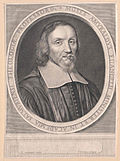 Moses Amyraut formulated Amyraldism, a modified Calvinist theology regarding the nature of Jesus' atonement. (from Reformed Christianity)
 -
-
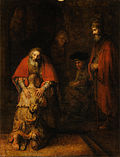 The Parable of the Prodigal Son, depicted in a portrait by Rembrandt, illustrates forgiveness. (from Reformed Christianity)
 -
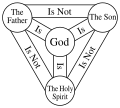 The Shield of the Trinity diagrams the classic doctrine of the Trinity. (from Reformed Christianity)
 -
 The Directory for Public Worship described what should (and should not) occur in worship. (from Reformed Christianity)
 -
 John Calvin depicted on his deathbed with church members in The last moments of Calvin, a late 19th century portrait by Lluís Domènech i Montaner (from Reformed Christianity)
 -
 Early Calvinism was known for simple, unadorned churches as depicted in this 1661 portrait of the interior of the Oude Kerk, Amsterdam. (from Reformed Christianity)
 -
 Stephen Bocskai, leader of Hungarian Calvinists in the anti-Habsburg rebellion and first Calvinist prince of Transylvania (r. 1605–1606) (from Reformed Christianity)
 -
 A Reformed church in Koudekerk aan den Rijn in the Netherlands in the 19th century (from Reformed Christianity)
 -
 The seal of the Presbyterian Church in the United States of America, an early American Presbyterian church founded in 1789 (from Reformed Christianity)
 -
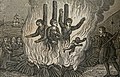 The burning of the Guernsey Martyrs during the Marian persecutions in 1556 (from Reformed Christianity)
 -
 Fall of Man by Jacob Jordaens (from Reformed Christianity)

.jpg)


,_by_Emanuel_de_Witte.jpg)


.jpg)

Did you know...

- ... that the 1919 demolition of "one of the most costly religious edifices" in New York City, the 1906 Madison Square Presbyterian Church, was called "a distinct architectural loss"?
- ...that Peter Martyr Vermigli's best known work, the Loci Communes, is a compilation of excerpts from his biblical commentaries published after his death?
- ... that the Presbyterian Church of Victoria was formed in 1859 as a union of Church of Scotland, Free Presbyterian and United Presbyterian congregations?
Subcategories
This article is sourced from Wikipedia. Content is available under the Creative Commons Attribution-ShareAlike License.