

The History Portal

History is the systematic study of the past, focusing primarily on the human past. As an academic discipline, it analyses and interprets evidence to construct narratives about what happened and explain why it happened. Some theorists categorize history as a social science, while others see it as part of the humanities or consider it a hybrid discipline. Similar debates surround the purpose of history—for example, whether its main aim is theoretical, to uncover the truth, or practical, to learn lessons from the past. In a more general sense, the term history refers not to an academic field but to the past itself, times in the past, or to individual texts about the past.
Historical research relies on primary and secondary sources to reconstruct past events and validate interpretations. Source criticism is used to evaluate these sources, assessing their authenticity, content, and reliability. Historians strive to integrate the perspectives of several sources to develop a coherent narrative. Different schools of thought, such as positivism, the Annales school, Marxism, and postmodernism, have distinct methodological approaches.
History is a broad discipline encompassing many branches. Some focus on specific time periods, such as ancient history, while others concentrate on particular geographic regions, such as the history of Africa. Thematic categorizations include political history, military history, social history, and economic history. Branches associated with specific research methods and sources include quantitative history, comparative history, and oral history.
History emerged as a field of inquiry in antiquity to replace myth-infused narratives, with influential early traditions originating in Greece, China, and later in the Islamic world. Historical writing evolved throughout the ages and became increasingly professional, particularly during the 19th century, when a rigorous methodology and various academic institutions were established. History is related to many fields, including historiography, philosophy, education, and politics. (Full article...)
 Featured articles –

-
 The 2nd Red Banner Army (Russian: 2-я Краснознамённая армия, romanized: 2-ya Krasnoznamennaya armiya) was a Soviet field army of World War II that served as part of the Far Eastern Front.
The army was formed at Khabarovsk in the Soviet Far East in 1938 as the 2nd Army. After the Far Eastern Front was split in September that year it became the 2nd Independent Red Banner Army. When the front was reformed in June 1940, the army was redesignated as the 2nd Red Banner Army, stationed in the Blagoveshchensk area. It spent the bulk of World War II guarding the border in that area, sending formations to the Eastern Front while undergoing several reorganizations. In August 1945, the army fought in the Soviet invasion of Manchuria, capturing the Japanese fortified regions of Aihun and Sunwu adjacent to its sector of the border, and advancing into Manchuria to Qiqihar. The army was disbanded after the war in late 1945. (Full article...) -
 Wochenspruch der NSDAP, displayed 7–13 September 1941, quotes Hitler's speech on 30 January 1939. (The rendition omits "inside and outside Europe" and "the Bolshevization of the earth and thereby"...)
During a speech at the Reichstag on 30 January 1939, Adolf Hitler, dictator of Nazi Germany, threatened "the annihilation of the Jewish race in Europe" in the event of another world war:
These words were similar to comments that Hitler had previously made to foreign politicians in private meetings after the Kristallnacht pogrom in November 1938. The speech was made in the context of Nazi attempts to increase Jewish emigration from Germany, before the outbreak of World War II in September 1939.If the international Jewish financiers in and outside Europe should succeed in plunging the nations once more into a world war, then the result will not be the Bolshevization of the earth, and thus the victory of Jewry, but the annihilation of the Jewish race in Europe!
Allusions to "Hitler's prophecy" by Nazi leaders and in Nazi propaganda were common after 30 January 1941, when Hitler mentioned it again in a speech. The prophecy took on new meaning with the invasion of the Soviet Union in June 1941 and the German declaration of war against the United States that December, both of which facilitated an acceleration of the systematic mass murder of Jews. In late 1941, Nazi propaganda chief Joseph Goebbels stated that the prophecy was being fulfilled while justifying the mass deportation of Jews from Germany. On 30 September 1942, Hitler referenced the prophecy in another speech, which was adapted into a November issue of Parole der Woche titled "They Will Stop Laughing!!!" Hitler continued to invoke the prophecy as the war went against Germany and referenced it in his last will and testament. Frequently used by Nazi leaders when alluding to their systematic murder of Jews, the prophecy became a leitmotif of the Final Solution and it is perhaps the best-known phrase from Hitler's speeches. (Full article...) -
The Rivadavia class consisted of two battleships designed by the American Fore River Shipbuilding Company for the Argentine Navy. Named Rivadavia and Moreno after important figures in Argentine history, they were Argentina's entry in the South American dreadnought race and a counter to Brazil's two Minas Geraes-class battleships.
In 1904, Brazil scrapped a previous naval building program in favor of an order that included three warships of the new "dreadnought" type, despite signs that such an action would spark a South American naval arms race. To counter this acquisition by a major rival, Argentina began seeking bids for at least two dreadnoughts in 1908. Over the next two years, shipbuilders from five countries vied for the contracts, complemented by efforts from their respective governments. Argentina was able to play this hyper-competitive environment to its own advantage by rejecting all of the initial proposals and calling for new ones that required the best aspects of each. They then repeated this process, despite complaints from shipbuilders that their trade secrets were being given away. The contracts were awarded to the lowest bidder, Fore River, in early 1910. This move shocked the European bidders, but could partly be explained by the American steel trust's ability to produce steel at a lower cost than any other country. (Full article...) -
Operation Obviate was an unsuccessful British air raid of World War II which targeted the German battleship Tirpitz. It was conducted by Royal Air Force heavy bombers on 29 October 1944, and sought to destroy the damaged battleship after she moved to a new anchorage near Tromsø in northern Norway.
The attack followed up the successful Operation Paravane on 15 September 1944, when Tirpitz was crippled by British heavy bombers. As Allied intelligence was unaware that the battleship could no longer operate at sea and warships needed elsewhere were being retained in British waters to counter her, it was decided to make another attack. After a period of planning and preparations, 38 British bombers and a film aircraft departed from bases in northern Scotland during the early hours of 29 October. The attack took place that morning, but was frustrated by clouds over the Tromsø area which made it difficult for the Allied airmen to accurately target Tirpitz. The battleship was not directly hit, but was damaged by a bomb that exploded near her hull. A British bomber made a crash landing in Sweden after being hit by German anti-aircraft fire, and several others were damaged. (Full article...) -

Major General Rupert Major Downes, CMG, KStJ, VD, FRACS (10 February 1885 – 5 March 1945) was an Australian soldier, surgeon and historian.
The son of British Army officer Major Francis Downes, Downes joined the Army as a trumpeter while he was still at school. He attended the University of Melbourne, graduating with his medical degrees in 1907 and a Doctor of Medicine degree in 1911. He was commissioned as a captain in the Australian Army Medical Corps in 1908, and after the outbreak of the First World War he joined the First Australian Imperial Force (AIF) in 1914 as its youngest lieutenant colonel. He served in the Gallipoli campaign, and was appointed Assistant Director of Medical Services (ADMS) of the newly formed Anzac Mounted Division in 1916, which he combined with the post of ADMS AIF Egypt. In 1917, he became Deputy Director of Medical Services (DDMS) of the Desert Mounted Corps. After the war, he wrote articles on medical aspects of the Sinai and Palestine campaign, and the section on the campaign for the Official History of Australia in the War of 1914–1918. (Full article...) -
Operation Teardrop was a United States Navy operation during World War II, conducted between April and May 1945, to sink German U-boats approaching the Eastern Seaboard that were believed to be armed with V-1 flying bombs. Germany had threatened to attack New York with V-1 flying bombs and rocket U-boats. After the war, it was determined the submarines had not been carrying either.
Operation Teardrop was planned during late 1944 in response to intelligence reports which indicated that Germany was preparing a force of missile-armed submarines. Two large U.S. Navy anti-submarine warfare task forces were set up. The plan was executed in April 1945 after several Type IX submarines put to sea from Norway bound for North America. While severe weather conditions in the North Atlantic Ocean greatly reduced the effectiveness of the four U.S. Navy escort carriers involved, long patrol lines of destroyer escorts detected and engaged most of the German submarines. Aircraft of the Royal Canadian Air Force supported this effort. (Full article...) -
Audie Leon Murphy (June 20, 1925 – May 28, 1971) was an American soldier, actor, and songwriter. He was widely celebrated as the most decorated American combat soldier of World War II, and has been described as the most highly decorated enlisted soldier in U.S. history. He received every military combat award for valor available from the United States Army, as well as French and Belgian awards for heroism. Murphy received the Medal of Honor for valor that he demonstrated at age 19 for single-handedly holding off a company of German soldiers for an hour at the Colmar Pocket in France in January 1945, before leading a successful counterattack while wounded.
Murphy was born into a large family of sharecroppers in Hunt County, Texas. His father abandoned the family and his mother died when Murphy was a teenager. Murphy left school in fifth grade to pick cotton and find other work to help support his family; his skill with a hunting rifle helped feed his family. After the attack on Pearl Harbor in 1941, Murphy's older sister helped him to falsify documentation about his birthdate to meet the minimum age for enlisting in the military. Turned down initially for being underweight by the Army, Navy, and the Marine Corps, he eventually was able to enlist in the Army. He first saw action in the 1943 Allied invasion of Sicily; then in 1944 he participated in the Battle of Anzio, the liberation of Rome, and the invasion of southern France. Murphy fought at Montélimar and led his men on a successful assault at L'Omet quarry near Cleurie in northeastern France in October. Despite suffering from multiple illnesses and wounds throughout his service, Murphy became one of the most praised and decorated soldiers of World War II. He is credited with killing 241 enemy soldiers. (Full article...) -
 Illustration of a bronze tablet from Pergamon, Asia Minor, dating to the 3rd century AD. An inscription mentions the goddess Melinoë, who is otherwise known only from the Orphic Hymns.
The Orphic Hymns are a collection of eighty-seven ancient Greek hymns addressed to various deities, which were attributed in antiquity to the mythical poet Orpheus. They were composed in Asia Minor (located in modern-day Turkey), most likely around the 2nd or 3rd centuries AD, and were used in the rites of a religious community which existed in the region. The Hymns are among the few extant works of Orphic literature (the tradition of texts attributed to Orpheus in antiquity), and recent scholars have observed parallels between the collection and other Orphic works.
The collection is preceded by a proem (or prologue), in which Orpheus addresses the legendary poet Musaeus, and calls upon around seventy deities to be present. The individual hymns in the collection, all of which are brief, typically call for the attention of the deity they address, before describing them and highlighting aspects of their divinity, and then appealing to them with a request. The descriptions of deities consist primarily of strings of epithets (titles or adjectives applied to gods), which make up a substantial portion of the hymns' content, and are designed to summon the powers of the god. The deity featured most prominently in the collection is Dionysus, who is the recipient of eight hymns, and is mentioned throughout the collection under various names. Most of the deities featured in the Hymns are derived from mainstream Greek mythology, and a number are assimilated with one another. (Full article...) -
The Wittelsbach-class battleships were a group of five pre-dreadnought battleships built for the German Kaiserliche Marine (Imperial Navy) in the early 1900s. They were the first battleships ordered under the First Navy Law of 1898, part of Admiral Alfred von Tirpitz's fleet expansion program. The class comprised the lead ship, Wittelsbach, and Wettin, Zähringen, Schwaben, and Mecklenburg. All five ships were laid down between 1899 and 1900 and were finished by 1904. The ships of the Wittelsbach class were similar in appearance to their predecessors in the Kaiser Friedrich III class, but had a more extensive armor belt and a flush main deck, as opposed to the lower quarterdeck of the previous class. Both classes carried a battery of four 24 cm (9.4 in) guns in two twin-gun turrets.
Wittelsbach, Wettin, Mecklenburg, and Zähringen served in I Squadron for the duration of their peacetime careers, where they were primarily occupied with training exercises and cruises abroad. Schwaben was used as a training ship to modernize the training unit of the German fleet. By 1910, with the arrival of the first dreadnought battleships, the Wittelsbach-class ships were removed from front-line service and relegated to training duties or simply laid up in reserve. With the outbreak of World War I in July 1914, the ships returned to active service as IV Battle Squadron, seeing guard duty in the North Sea and limited operations in the Baltic Sea against Russian forces. These operations included supporting the attack on Libau in May 1915 and the Battle of the Gulf of Riga in August that year. (Full article...) -
Capon Chapel ( /ˈkeɪpən/ KAY-pən), also historically known as Capon Baptist Chapel and Capon Chapel Church, is a mid-19th century United Methodist church located near to the town of Capon Bridge, West Virginia, in the United States. Capon Chapel is one of the oldest existing log churches in Hampshire County, along with Mount Bethel Church and Old Pine Church.
A Baptist congregation was gathering at the site of the present-day church by at least 1756. Primitive Baptist minister John Monroe (1750–1824) is credited for establishing a place of worship at this site; he is interred in the church's cemetery. The land on which Capon Chapel was built originally belonged to William C. Nixon (1789–1869), a member of the Virginia House of Delegates; later, it was transferred to the Pugh family. The first documented mention of a church at the Capon Chapel site was in March 1852, when Joseph Pugh allocated the land to three trustees for the construction of a church and cemetery. (Full article...) -
SMS Friedrich der Grosse was the second vessel of the Kaiser class of dreadnought battleships of the German Imperial Navy. Friedrich der Grosse's keel was laid on 26 January 1910 at the AG Vulcan dockyard in Hamburg, her hull was launched on 10 June 1911, and she was commissioned into the fleet on 15 October 1912. The ship was equipped with ten 30.5-centimeter (12 in) guns in five twin turrets, and had a top speed of 23.4 knots (43.3 km/h; 26.9 mph). Friedrich der Grosse was assigned to III Battle Squadron of the High Seas Fleet for the majority of World War I, and served as fleet flagship from her commissioning until 1917.
Along with her four sister ships, Kaiser, Kaiserin, König Albert, and Prinzregent Luitpold, Friedrich der Grosse participated in all the major fleet operations of World War I, including the Battle of Jutland on 31 May – 1 June 1916. Toward the center of the German line, Friedrich der Grosse was not as heavily engaged as the leading German ships, such as the battleships König and Grosser Kurfürst and the battlecruisers of I Scouting Group—Friedrich der Grosse emerged from the battle completely unscathed. In 1917, the new battleship Baden replaced Friedrich der Grosse as the fleet flagship. (Full article...) -
John Lloyd Waddy, OBE, DFC (10 December 1916 – 11 September 1987) was a senior officer and aviator in the Royal Australian Air Force (RAAF), and later served as a member of the New South Wales Legislative Assembly and as a minister in the New South Wales government. As a fighter pilot during World War II, he shot down 15 enemy aircraft during the North African campaign, becoming one of Australia's top-scoring aces and earning the Distinguished Flying Cross. Waddy went on to command No. 80 Squadron in the South West Pacific, where he was awarded the US Air Medal. He was one of eight senior pilots who took part in the "Morotai Mutiny" of April 1945.
Discharged from the Permanent Air Force at the end of the war, Waddy took a commission in the RAAF Reserve and led the organisation as a group captain in the early 1950s. He was active in business and in veterans' groups, and was appointed an Officer of the Order of the British Empire in 1955. From 1962 to 1976, he was the Member for Kirribilli in the New South Wales Parliament, representing the Liberal Party. He held cabinet posts including Minister for Child Welfare and Social Welfare (later Youth and Community Services), Minister for Health, and Minister for Police and Services. Waddy retired from politics in 1976, and died in 1987 at the age of 70. (Full article...) -
SMS Kaiser Karl der Grosse was a German pre-dreadnought battleship of the Kaiser Friedrich III class, built around the turn of the 20th century for the Kaiserliche Marine (Imperial Navy). Named for the Emperor Charlemagne, Kaiser Karl der Grosse was built in Hamburg, at the Blohm and Voss shipyard. She was laid down in September 1898 and launched in October 1899. A shipyard strike and an accidental grounding delayed her completion until February 1902; she was therefore the last member of her class to enter service. The ship was armed with four 24-centimeter (9.4 in) guns in two twin gun turrets and had a top speed of 17.5 knots (32.4 km/h; 20.1 mph).
Kaiser Karl der Grosse served with the active fleet until 1908, participating in the normal peacetime routine of training cruises and fleet maneuvers. By 1908, the new "all-big-gun" dreadnought battleships were entering service. As these rendered her obsolete, Kaiser Karl der Grosse was withdrawn from active service and placed in the Reserve Division. At the outbreak of World War I in August 1914, the ship was placed back in active duty as a coastal defense ship in V Battle Squadron, though by February 1915 she was again placed in reserve. Kaiser Karl der Grosse was briefly used as a training ship and ended her career as a prison ship for prisoners of war in Wilhelmshaven. After the German defeat in November 1918, she was sold to ship-breakers and scrapped in 1920. (Full article...) -

Humphrey Stafford, 1st Duke of Buckingham, 6th Earl of Stafford, 7th Baron Stafford (15 August 1402 – 10 July 1460) of Stafford Castle in Staffordshire, was an English nobleman and a military commander in the Hundred Years' War and the Wars of the Roses. Through his mother he was of royal descent from King Edward III, his great-grandfather, while from his father, he inherited, at an early age, the earldom of Stafford. By his marriage to a daughter of Ralph, Earl of Westmorland, Humphrey was related to the powerful Neville family and to many of the leading aristocratic houses of the time. He joined the English campaign in France with King Henry V in 1420. Following Henry V's death two years later he became a councillor for the new king, the nine-month-old Henry VI. Stafford acted as a peacemaker during the factional politics of the 1430s, when Humphrey, Duke of Gloucester, vied with Cardinal Beaufort for political supremacy. Stafford also took part in the eventual arrest of Gloucester in 1447.
Stafford returned to the French campaign during the 1430s, and for his loyalty he was elevated from Earl of Stafford to Duke of Buckingham. Around the same time, his mother died. As much of his estate—as her dower—had previously been in her hands, Humphrey went from having a reduced income in his early years to being one of the wealthiest and most powerful landowners in England. His lands stretched across much of the country, ranging from East Anglia to the Welsh border. Being such an important figure in the localities was not without its dangers and for some time he feuded violently with Sir Thomas Malory in the Midlands. (Full article...) -
 Station Sergeant Thomas Green, killed in the Epsom riot, June 1919
The Epsom riot took place on 17 June 1919 when between 300 and 800 Canadian soldiers rioted and attacked the police station in Epsom, Surrey, England. Station Sergeant Thomas Green, a British police officer, was injured during the incident and died the following day.
The Canadians were from the nearby Woodcote Park Convalescent Hospital, a former temporary military base that had been converted for use as a convalescent hospital. With the First World War over, discipline at the camp was relaxed. Delays in repatriating Canadian soldiers had resulted in thirteen riots by troops in British camps between November 1918 and June 1919. The riot began when two Canadian servicemen were arrested following a disturbance at a local public house. Their comrades marched on the town police station to demand their release. The soldiers ripped up the railings surrounding the station to use as projectiles and clubs. In the ensuing fighting, Private Allan McMaster, a former blacksmith, picked up a metal bar and struck Green on the head. The sergeant died the following day, having never regained consciousness. (Full article...)


.png)


Featured picture
-
 Photo: William Henry Jackson; Restoration: Lise BroerA man climbs a statue of a Buddhist idol at Borobudur, a 9th-century Mahayana Buddhist monument near Magelang, Central Java, Indonesia, in this 1895 hand-tinted lantern slide. The monument comprises six square platforms topped by three circular platforms, and is decorated with 2,672 relief panels and 504 Buddha statues. The monument is both a shrine to the Lord Buddha and a place for Buddhist pilgrimage. Evidence suggests Borobudur was abandoned following the 14th-century decline of Buddhist and Hindu kingdoms in Java, and the Javanese conversion to Islam. The monument is a UNESCO World Heritage Site and is the most popular tourist attraction in the country.
 -
 Artist: Kasai Torajirō; Restoration: StaxringoldJapanese and British troops attack members of the Society of Righteous and Harmonious Fists ("Boxers") at Beijing Castle during the Boxer Rebellion of 1899–1901. The Boxers, angered by foreign imperialist expansion into Qing Dynasty China, had engaged in looting, arson, and killings of foreigners. In 1900, the Empress Dowager Cixi employed the Boxers to attack foreign settlements in Beijing. The uprising was eventually put down by 20,000 troops from the Eight-Nation Alliance.
 -
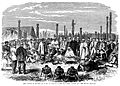 Illustration credit: M. Jackson, Illustrated London NewsThe traditional clothing of the Māori can be seen in this engraving of a meeting between Māori and settlers in Hawke's Bay Province during the Invasion of Waikato in 1863. Muka, the fibre of New Zealand flax, was the basis of most clothing.
 -
 Woodcut: Hans Burgkmair; print: David de NegkerA woodcut print of the Quaternion Eagle, the double-headed eagle armorial of the Holy Roman Empire. It showed the shields of the various parts of the empire in groups of four on the feathers of the eagle supporting, in place of a shield, Christ on the True Cross. The top, larger shields, are those of the seven Prince-electors, as well as one for the titular "Prefect of Rome".
 -
 1895 train wreck, Gare MontparnassePhoto credit: Studio Lévy and SonsOn October 22, 1895, the Granville–Paris Express train overran the buffer stop at Gare Montparnasse station. The engine careened across almost 30 metres (100 feet) of the station concourse, crashed through a 60 centimetre thick wall, shot across a terrace and sailed out of the station, plummeting onto the Place de Rennes 10 metres (30 feet) below where it stood on its nose. While all of the passengers on board the train survived, one woman on the street below was killed by falling masonry.
 -
 Artist: UnknownA 1786 depiction of the first hot air balloon to carry humans, built by the Montgolfier brothers of Annonay, France. The flight occurred on 21 November 1783 from the grounds of the Château de la Muette in the western outskirts of Paris. Jean-François Pilâtre de Rozier, a physician, and François Laurent d'Arlandes, an army officer, flew aloft about 3,000 feet (1,000 m) above the city for a distance of 9 kilometres (6 mi), with a total flying time of 25 minutes.
 -
 Photo credit: USHMMJews captured by SS and SD troops during the suppression of the Warsaw Ghetto Uprising are forced to leave their shelter and march to the Umschlagplatz for deportation. The SD trooper pictured second from the right, is Josef Blösche, who was identified by Polish authorities using this photograph. Blösche was tried for war crimes in Erfurt, East Germany in 1969, sentenced to death and executed in July of that year.
 -
 Illustration: Anton Sorg; Restoration: Lise BroerA knight, a member of the warrior class of the Middle Ages in Europe, in Gothic plate armour, from a German book illustration published 1483. The modern concept of the knight is as an elite warrior sworn to uphold the values of chivalry, faith, loyalty, courage and honour. Knighthood as known in Medieval Europe was characterized by the combination of two elements: feudalism and service as a mounted combatant. Both arose under the reign of the Holy Roman Emperor Charlemagne, from which the knighthood of the Middle Ages can be seen to have had its genesis.
 -
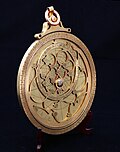 Photograph: Masoud SafarniyaAn Iranian astrolabe, handmade from brass by Jacopo Koushan in 2013. Astrolabes are elaborate inclinometers used by astronomers, navigators, and astrologers from classical antiquity, through the Islamic Golden Age and European Middle Ages, until the Renaissance. These could be used for a variety of purposes, including predicting the positions of the Sun, Moon, planets, and stars; determining local time given local latitude; surveying; triangulation; calculating the qibla; and finding the times for salat.
 -
![Image 10 Apollo 11 Photograph credit: Neil Armstrong Apollo 11 was the fifth crewed mission of NASA's Apollo program. After launching from the Kennedy Space Center in Florida on July 16, 1969, commander Neil Armstrong and Apollo Lunar Module pilot Buzz Aldrin landed Eagle in Mare Tranquillitatis on July 20, at 20:17:40 UTC, while command module pilot Michael Collins remained on Columbia in lunar orbit. Armstrong was the first to exit the spacecraft, stepping onto the surface 6 hours and 39 minutes later, on July 21, at 02:56:15 UTC; nineteen minutes later, Aldrin joined him on extravehicular activity, which lasted 2 hours, 31 minutes and 40 seconds. Armstrong and Aldrin lifted off from Tranquility Base after almost 22 hours on the lunar surface and rejoined Collins in the command module, before splashing down in the Pacific Ocean on July 24. The mission was planned to the minute, with the majority of the photographic tasks performed by Armstrong with a single Hasselblad camera. Most of the photographs taken on the Moon that include an astronaut are of Aldrin; there are only five images of Armstrong partly shown or reflected, as in this photograph, with Armstrong and the lunar module reflected in Aldrin's helmet visor. "As the sequence of lunar operations evolved," Aldrin explained, "Neil had the camera most of the time [...] It wasn't until we were back on Earth and in the Lunar Receiving Laboratory looking over the pictures that we realized there were few pictures of Neil." More featured pictures](//upload.wikimedia.org/wikipedia/commons/thumb/9/98/Aldrin_Apollo_11_original.jpg/120px-Aldrin_Apollo_11_original.jpg) Photograph credit: Neil ArmstrongApollo 11 was the fifth crewed mission of NASA's Apollo program. After launching from the Kennedy Space Center in Florida on July 16, 1969, commander Neil Armstrong and Apollo Lunar Module pilot Buzz Aldrin landed Eagle in Mare Tranquillitatis on July 20, at 20:17:40 UTC, while command module pilot Michael Collins remained on Columbia in lunar orbit. Armstrong was the first to exit the spacecraft, stepping onto the surface 6 hours and 39 minutes later, on July 21, at 02:56:15 UTC; nineteen minutes later, Aldrin joined him on extravehicular activity, which lasted 2 hours, 31 minutes and 40 seconds. Armstrong and Aldrin lifted off from Tranquility Base after almost 22 hours on the lunar surface and rejoined Collins in the command module, before splashing down in the Pacific Ocean on July 24.
Photograph credit: Neil ArmstrongApollo 11 was the fifth crewed mission of NASA's Apollo program. After launching from the Kennedy Space Center in Florida on July 16, 1969, commander Neil Armstrong and Apollo Lunar Module pilot Buzz Aldrin landed Eagle in Mare Tranquillitatis on July 20, at 20:17:40 UTC, while command module pilot Michael Collins remained on Columbia in lunar orbit. Armstrong was the first to exit the spacecraft, stepping onto the surface 6 hours and 39 minutes later, on July 21, at 02:56:15 UTC; nineteen minutes later, Aldrin joined him on extravehicular activity, which lasted 2 hours, 31 minutes and 40 seconds. Armstrong and Aldrin lifted off from Tranquility Base after almost 22 hours on the lunar surface and rejoined Collins in the command module, before splashing down in the Pacific Ocean on July 24.
The mission was planned to the minute, with the majority of the photographic tasks performed by Armstrong with a single Hasselblad camera. Most of the photographs taken on the Moon that include an astronaut are of Aldrin; there are only five images of Armstrong partly shown or reflected, as in this photograph, with Armstrong and the lunar module reflected in Aldrin's helmet visor. "As the sequence of lunar operations evolved," Aldrin explained, "Neil had the camera most of the time [...] It wasn't until we were back on Earth and in the Lunar Receiving Laboratory looking over the pictures that we realized there were few pictures of Neil." -
 Photograph: Felice BeatoA samurai with his sword and armor, photographed by Felice Beato c. 1860. The samurai, records of which date back to the early 10th-century Kokin Wakashū, were the military nobility of medieval and early-modern Japan. As Japan modernized during the Meiji period beginning in the late 1860s, the samurai lost much of their power, and the status was ultimately dissolved. However, samurai values remain common in Japanese society.
 -
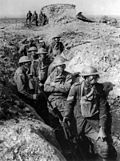 Photo credit: Frank HurleyA group of Australian infantry wearing Small Box Respirators (SBRs) at the Third Battle of Ypres in September 1917. After the introduction of poison gas in World War I, countermeasures were developed. SBRs represented the pinnacle of gas mask development during the war, a mouthpiece connected via a hose to a box filter (hanging around the wearer's neck in this picture), which in turn contained granules of chemicals that neutralised the gas. The SBR was the prized possession of the ordinary infantryman; when the British were forced to retreat during the German Spring Offensive of 1918, it was found that while some troops had discarded their rifles, hardly any had left behind their respirators.
 -
 Photo credit: Gustaf NordenskiöldAn 1891 photograph of Cliff Palace, the largest cliff dwelling—a structure built within caves and under outcroppings in cliffs—in North America, located in what is now Mesa Verde National Park, Colorado, USA. There are about 150 rooms in the 288 ft (88 m) long structure, although only 25 to 30 of those were used as living space by Ancient Pueblo peoples. it is estimated that the population of Cliff Palace was roughly 100–150 people.
 -
 Chromolithograph: Romanet & cie.A 19th-century set of ten cards depicting events in the history of ballooning and parachuting. These cards depict, from left to right:
Top row:- Joseph Louis Gay-Lussac and Jean-Baptiste Biot reaching an altitude of 4,000 metres (13,000 ft) (1804)
- André-Jacques Garnerin making a parachute descent in his gondola (1797)
- Louis-Sébastien Lenormand making the first witnessed parachute descent (1783)
- A series of fantastic flying machines dreamed up during the 18th century
- Use of balloons for reconnaissance during the Battle of Mainz (1795)
Bottom row:- The coronation balloon of Napoleon I (1804)
- The death of Sophie Blanchard (1819)
- Francesco Zambeccari and two companions adrift in the Adriatic Sea (1804)
- The death of Thomas Harris (1824)
- Francesco Arban is rescued by Italian fishermen (1846)
-
 The "Theatre" at PetraPhoto: Douglas PerkinsPetra is an archaeological site in Jordan, lying in a basin among the mountains which form the eastern flank of Wadi Araba, the great valley running from the Dead Sea to the Gulf of Aqaba. It is famous for having many stone structures carved into the rock.
 -
 A Chola dynasty sculpture depicting Shiva. In Hinduism, Shiva is the deity of destruction and one of the most important gods; in this sculpture he is dancing as Nataraja, the divine dancer who unravels the world in preparation for it being remade by Brahma.
 -
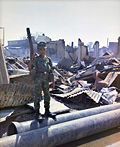 Photo credit: J.F. Fitzpatrick, Jr., SPC5, U.S. Army Signal CorpsThis twelve-year old ARVN Airborne trooper poses with an M79 grenade launcher during a sweep through the devastated Plantation Road area after a day-long battle near Tan Son Nhut during the Vietnam War. The young soldier had been "adopted" by the US Army Airborne Division.
 -
 Photo: American Colony; Restoration: Sebastian KolendoThe Mayor of Jerusalem Hussein al-Husayni (centre) meets with soldiers of the British Egyptian Expeditionary Force on December 9, 1917, under the white flag of surrender. The Battle of Jerusalem had begun the day before, but the Turkish forces in the city were no match against the British forces. A Turkish counterattack on December 25 was also repulsed, confirming the capture of Jerusalem by the Allies.


![Image 10 Apollo 11 Photograph credit: Neil Armstrong Apollo 11 was the fifth crewed mission of NASA's Apollo program. After launching from the Kennedy Space Center in Florida on July 16, 1969, commander Neil Armstrong and Apollo Lunar Module pilot Buzz Aldrin landed Eagle in Mare Tranquillitatis on July 20, at 20:17:40 UTC, while command module pilot Michael Collins remained on Columbia in lunar orbit. Armstrong was the first to exit the spacecraft, stepping onto the surface 6 hours and 39 minutes later, on July 21, at 02:56:15 UTC; nineteen minutes later, Aldrin joined him on extravehicular activity, which lasted 2 hours, 31 minutes and 40 seconds. Armstrong and Aldrin lifted off from Tranquility Base after almost 22 hours on the lunar surface and rejoined Collins in the command module, before splashing down in the Pacific Ocean on July 24. The mission was planned to the minute, with the majority of the photographic tasks performed by Armstrong with a single Hasselblad camera. Most of the photographs taken on the Moon that include an astronaut are of Aldrin; there are only five images of Armstrong partly shown or reflected, as in this photograph, with Armstrong and the lunar module reflected in Aldrin's helmet visor. "As the sequence of lunar operations evolved," Aldrin explained, "Neil had the camera most of the time [...] It wasn't until we were back on Earth and in the Lunar Receiving Laboratory looking over the pictures that we realized there were few pictures of Neil." More featured pictures](/wiki/File:Aldrin_Apollo_11_original.jpg)


Did you know (auto generated)

- ... that Kang Ju-hyeok became the youngest player in FC Seoul's history at the age of 17 years, 9 months, and 6 days?
- ... that in the history of fisheries in the Philippines, the once-dominant local municipal fisheries were supplanted first by commercial fisheries, and then by aquaculture?
- ... that the live stream of the cassation hearing for Larisa Dolina's apartment deal was the most-watched in the history of the Supreme Court of Russia?
- ... that the Harlem Park Three were awarded US$48 million, the largest sum in Baltimore history, after being falsely imprisoned for murder?
- ... that in a copyright infringement case over a coffee-table history of the Grateful Dead, the Second Circuit held that a reuser can still claim fair use despite negotiating with the rights holder?
- ... that archaeological excavations in the historic town of Kharayeb revealed a rural settlement with a complex system of cisterns and a Phoenician temple?
Featured biography –
.jpg)
Kaikhosru Shapurji Sorabji (born Leon Dudley Sorabji; 14 August 1892 – 15 October 1988) was an English composer, music critic, pianist and writer. His music, written over a period of seventy years, ranges from sets of miniatures to works lasting several hours. One of the most prolific 20th-century composers, he is best known for his piano pieces, notably nocturnes such as Gulistān and Villa Tasca, and large-scale, technically intricate compositions, which include seven symphonies for piano solo, four toccatas, Sequentia cyclica and 100 Transcendental Studies. He felt alienated from English society by reason of his homosexuality and mixed ancestry, and had a lifelong tendency to seclusion.
Sorabji was educated privately. His mother was English and his father a Parsi businessman and industrialist from India, who set up a trust fund that freed his family from the need to work. Although Sorabji was a reluctant performer and not a virtuoso, he played some of his music publicly between 1920 and 1936. In the late 1930s, his attitude shifted and he imposed restrictions on performance of his works, which he lifted in 1976. His compositions received little exposure in those years and he remained in public view mainly through his writings, which include the books Around Music and Mi contra fa: The Immoralisings of a Machiavellian Musician. During this time, he also left London and eventually settled in the village of Corfe Castle, Dorset. Information on Sorabji's life, especially his later years, is scarce, with most of it coming from the letters he exchanged with his friends. (Full article...)
On this day
February 28: Kalevala Day in Finland; Peace Memorial Day in Taiwan

- 202 BC – Rebel leader Liu Bang declared himself Emperor Gaozu of Han after overthrowing the Qin dynasty, the first imperial dynasty of China.
- 1897 – Ranavalona III (pictured), the last sovereign ruler of the Kingdom of Madagascar, was deposed by French military forces.
- 1928 – Indian physicist C. V. Raman and his colleagues discovered what is now known as Raman scattering, for which he later became the first Asian to win the Nobel Prize in Physics.
- 1975 – A London Underground train failed to stop at the terminal Moorgate station, crashing and causing the deaths of 43 people.
- 2002 – During a period of religious violence in Gujarat, India, mobs of Hindus attacked Muslims in Naroda Patiya and in Chamanpura, resulting in 166 deaths.
- Cornelius Gemma (b. 1535)
- Alfred von Schlieffen (b. 1833)
- Charles Bassett and Elliot See (d. 1966)
- Koesbini (d. 1991)
Selected quote
Those who would give up Essential Liberty to purchase a little Temporary Safety, deserve neither Liberty nor Safety.
— Benjamin Franklin, American statesman
Related portals


More Did you know...
.jpg)
- ... that the anti-religious campaign culminating in the Stalinist show trial of the Kraków Curia (pictured) led to the imprisonment of 123 Polish Roman Catholic priests in just one year?
- ... that Confederate brigadier general Alfred E. Jackson was pardoned by President Andrew Johnson because of his kindness toward Johnson's family during the Civil War?
- ... that after HMS Porcupine was nearly split in two by a torpedo, the halves were nicknamed HMS Pork and HMS Pine?
- ... that the Experiment was a boat powered by horses running on a treadmill and propelled by a then-novel type of screw propeller?
- ... that one of the highest-ranking generals in China was injured in battle nine times?
- ... that in Mesopotamian mythology, the Apkallu were sent by the god Enki, from Dilmun to teach human beings various aspects of civilization?
- ... that Karl Marx's theory of historical trajectory attempted to prove the long-term unsustainability of capitalism?
- ... that in November 1921, the schooner Cymric collided with a tram in Dublin?
Topics
| Primary | |
|---|---|
| Interdisciplinary |
|
| List | |
| Other categorizations | |

| Key concepts | |||||||||
|---|---|---|---|---|---|---|---|---|---|
| Measurement and standards |
| ||||||||
| Philosophy of time | |||||||||
| Human experience and use of time | |||||||||
| Time in science |
| ||||||||
| Related | |||||||||

Categories

This article is sourced from Wikipedia. Content is available under the Creative Commons Attribution-ShareAlike License.