
Osijek | |
|---|---|
| Grad Osijek City of Osijek | |
 Flag  Coat of arms | |
| Nicknames: Grad na Dravi (City on Drava), Nepokoreni grad (Unconquered City) | |
 Interactive map of Osijek | |
  Osijek Location of Osijek in Croatia | |
| Coordinates: 45°33′20″N 18°41′40″E / 45.55556°N 18.69444°E | |
| Country |  Croatia Croatia |
| Region | Slavonia |
| County |  Osijek-Baranja Osijek-Baranja |
| Government | |
| • Mayor | Ivan Radić (HDZ) |
| • City Council | |
| • Electoral district | IV |
| Area | |
• City | 174.9 km2 (67.5 sq mi) |
| • Urban | 59.1 km2 (22.8 sq mi) |
| Elevation | 94 m (308 ft) |
| Population (2021)[2] | |
• City | 96,313 |
| • Density | 550.7/km2 (1,426/sq mi) |
| • Urban | 75,535 |
| • Urban density | 1,280/km2 (3,310/sq mi) |
| Time zone | UTC+1 (CET) |
| • Summer (DST) | UTC+2 (CEST) |
| Postal code | 31000 |
| Area code | 31 |
| Vehicle registration | OS |
| Climate | Cfb |
| Website | osijek.hr |


.jpg)


Osijek (Croatian pronunciation: [ôsijeːk] ⓘ) is the largest city and the economic and cultural hub of the eastern Croatian region of Slavonia, as well as the administrative seat of Osijek-Baranja County. It is the fourth-largest city in Croatia, with a population of 96,313 recorded in the 2021 census.[3] The city is situated on the southern bank of the Drava River, 25 km (16 mi) upstream from its confluence with the Danube, at an elevation of 94 m (308 ft). Osijek is located 16 km (10 mi) west of the Croatia–Serbia border.
Name
[edit]Osijek's name originates from its location on elevated ground, which afforded protection from floods in the surrounding swamp areas. It derives from the Croatian word oseka, meaning "ebb tide." Due to its history under the Habsburg monarchy and Ottoman Empire, as well as its diverse ethnic minorities, the city is known by various names in other languages: Eszék in Hungarian, Esseg in German, Ösek in Turkish,[4] and Mursa in Latin. The English name for the city is Osijek.[5][6]
History
[edit]Origins
[edit]Human habitation in the Osijek area dates to the Neolithic period.[7] The first known inhabitants were the Illyrian tribe of the Andizetes. During the second half of the 4th century BC, the settlement was attacked and subsequently captured by the Celtic Scordisci, who established a permanent presence there.[8]
 Plan of Tvrđa in Osijek 1861
 Bastion in Tvrđa
Following the Roman conquest of Pannonia, the settlement—then known as Mursa—was garrisoned by the Roman Seventh Legion. The legion administered the area from a military castrum and built a bridge across the Drava River. Historical evidence suggests that Emperor Hadrian founded this settlement as a new foundation.[9] He later elevated Mursa to a colony with special privileges in 133 AD. The subsequent history of Mursa was marked by turbulence, as several decisive battles were fought in its vicinity. These conflicts had profound consequences for the colony and the wider region, which was already strained due to the westward migration of various tribes—including the Alemanni, Gepids, Goths, Marcomanni, and Vandals—who were displaced by the invading Huns. After the collapse of the Western Roman Empire and the Avar Khaganate's destruction of local tribes in the 6th century, the region was repopulated by Slavic tribes during their mass migrating to Southeastern Europe in the Early Middle Ages, between the 6th and 7th centuries.
The earliest recorded mention of Osijek dates to 1196.[10] From 1353 to 1472, the town was a feudal possession of the Kórógyi family.[11] Following the death of the last Kórógyi, King Matthias Corvinus transferred authority over Osijek to the Rozgonyi family. The city was subsequently sacked and nearly destroyed by an invading Ottoman army on 8 August 1526, just prior to the Battle of Mohács.[10][12] A permanent Turkish garrison was established in 1529,[13] after which the Ottoman rebuilt the city in an oriental style; it appears in the Ottoman census of 1579.[14] In 1566, Suleiman the Magnificent commissioned an 8-kilometre-long, wooden pontoon bridge at Osijek, a structure renowned in its time as one of the wonders of the world.[15] Under Ottoman administration, Osijek was part of the Sanjak of Pojega within the Budin Eyalet and grew into a significant commercial centre for East-West trade.[4]
Osijek was captured by Habsburg forces on 29 September 1687, following the Second Battle of Mohács; this ended over 150 years of Ottoman rule over the city.[16]
.png) Battle of Osijek, fought on 11 August 1685 between the Imperial Habsburg army, commanded by James, 2nd Count Leslie, and the Turks, resulting in an Habsburg victory
Battle of Osijek, fought on 11 August 1685 between the Imperial Habsburg army, commanded by James, 2nd Count Leslie, and the Turks, resulting in an Habsburg victory
 Osijek 1904
 Osijek Co-Cathedral of St. Peter and Paul from the 19th century. Pictured: dedication of the co-cathedral in Osijek
Habsburg Empire
[edit]Following its integration into the Habsburg Empire, Osijek underwent significant reconstruction.[17] Between 1712 and 1715, Austrian authorities built a new fortress, known as Tvrđa, in the town's center. Designed by Austrian architect Maximilian Gosseau de Henef, it was completed with outer walls and all five of its planned bastions.[18] The central Holy Trinity Square is framed by the Military Command building to the north, the Main Guard building to the west, and the Magistrate building (now the Museum of Slavonia) to the east. At its center, a monument to the plague was erected in 1729 by the widow of General Maximilian Petras.[19]
 Osijek, European Avenue, 1910–1920
The Gornji Grad (Upper Town) was established in 1692, followed shortly by the Donji Grad (Lower Town) in 1698. These districts were primarily settled by inhabitants from the swampy Baranja region. Tvrđa, Gornji Grad, and Donji Grad operated as separate municipalities until 1786, when they were unified into a single administrative entity.[20] In the late 18th century, Osijek superseded Virovitica as the seat of Virovitica County. During this period, the Habsburg Empire encouraged the migration and settlement of German immigrants into the town and surrounding region,[21] which led to the development of a distinctive local German dialect known as Essekerisch.[22][21]
In 1809, Osijek was granted the title of a Free Royal City, and during the early 19th century, it was the largest city in Croatia.[23] The city developed along the lines of other central European cities, with cultural, architectural, and socio-economic influences filtering down from Vienna and Buda.[24] At the beginning of the Hungarian Revolution of 1848, the town was initially held by Hungarian forces but was captured by the Austrians under General Baron Trebersberg on 4 February 1849.[25]
In the late 19th and early 20th centuries, Osijek was the seat of the Virovitica County[25] of the autonomous territory of the Kingdom of Croatia-Slavonia in Austria-Hungary.[26]
During the 19th century, cultural life in Osijek flourished around its theatres, museums, collections, and printing houses, notably those run by the Franciscans. The first museum, the Museum of Slavonia, was founded in 1877 through private donations.[27] A prosperous economy and expanding trade relations fostered a vibrant society, characterized by religious festivals, public fairs, entertainment, and sporting events. This period of growth also saw significant urban expansion with the construction of the Novi Grad (New Town) district and the development of the Retfala area to the west.[28]
Twentieth century
[edit]The city expanded in the 20th century with the development of new residential districts, including Sjenjak, Vijenac, Ivana Meštrovića, Novi Grad, and Jug II. Osijek's riverside setting and its cultural and historical heritage, most notably the Baroque citadel of Tvrđa—one of the most distinctive architectural complexes in the region—have been significant factors in the growth of its tourism sector. Separately, during World War II, the Osijek oil refinery was a target for Allied bombing raids as part of the broader Oil Campaign.[29]
In the aftermath of the war, the local German-speaking population was expelled.[30] The daily newspaper Glas Slavonije was relocated to Osijek, where it has been published ever since.[31] The post-war period saw the establishment of several key institutions: the city's historical archive was founded in 1947, followed by the city library (GISKO) in 1949. This cultural expansion continued with the opening of a children's theatre and an art gallery. For public safety, the volunteer fire department DVD "Hrvatska Elektroprivreda" was founded in 1950, operating separately from the DVD "Vodovod", which had been established in 1947.[32] Continuing the tradition of promoting national heritage, especially in music and the arts, the tamburitza band "Pajo Kolarić" was founded on 21 March 1954.[33]
 Osijek Co-cathedral
Osijek's modern infrastructure began to develop significantly in the late 1950s and 1960s. In 1958, it was connected to Zagreb and Belgrade by a modern paved road, and a new bridge over the Drava River was constructed to the north in 1962. This period also saw the foundation of higher education in the city. The first faculty was the Faculty of Economy (established in 1959 as a study centre of the University of Zagreb)[34], which was immediately followed by schools that would become the Faculty of Agriculture[35] and the Faculty of Philosophy. The founding of the Faculty of Law in 1975[36] marked a key milestone, as it became a charter member of the newly established University of Osijek.
Concurrently, Osijek solidified its role as a regional centre for food and agriculture, exemplified by the establishment of a major agricultural collective in 1962. Further enhancing city life, a new pedestrian suspension bridge was built over the Drava River in the 1980s.
Croatian War of Independence
[edit] War of Independence memorial
.jpg) Red Fićo installation
Red Fićo installation
During the Croatian War of Independence (1991–1995), Osijek sustained extensive damage from prolonged shelling by the Yugoslav People's Army (JNA) and Serbian paramilitary units, notably the Serb Volunteer Guard under Željko Ražnatović. The city centre, including the Co-cathedral of St. Peter and St. Paul,[37] and outlying areas were heavily damaged. From August 1991 to June 1992 alone, approximately 800 people were killed by the shelling.[38] Overall, the war claimed the lives of 1,724 residents of Osijek, including 1,327 soldiers and 397 civilians.[39] Separately, several Croatian officials, including General Branimir Glavaš, were subsequently convicted of war crimes against Serb civilians in the city.[40]
Climate
[edit]Osijek has an oceanic climate (Köppen climate classification Cfb).
Since records began in 1981, the highest temperature recorded at the airport, at an elevation of 88 metres (289 ft), was 40.6 °C (105.1 °F), on 24 July 2007. The coldest temperature was −26.2 °C (−15.2 °F), on 9 February 2012.[41] The highest temperature recorded in Osijek itself, where records began in 1899, was 40.3 °C (104.5 °F), on both 1 July 1950 and 24 August 2012.[42] The coldest temperature was −27.1 °C (−16.8 °F), on 31 January 1987.[43] From 1981 to 1991, the lowest temperature at the RC Čepin station was −27.4 °C (−17.3 °F), on 31 January 1987.[44] Since records began in 2011, the coldest temperature at the Tvrđavica station was −25.6 °C (−14.1 °F), on 9 February 2012.[45]
| Climate data for Osijek (1971–2000, extremes 1899–2014) | |||||||||||||
|---|---|---|---|---|---|---|---|---|---|---|---|---|---|
| Month | Jan | Feb | Mar | Apr | May | Jun | Jul | Aug | Sep | Oct | Nov | Dec | Year |
| Record high °C (°F) | 19.0 (66.2) |
23.0 (73.4) |
26.9 (80.4) |
30.9 (87.6) |
36.0 (96.8) |
39.6 (103.3) |
40.3 (104.5) |
40.3 (104.5) |
37.1 (98.8) |
30.5 (86.9) |
25.8 (78.4) |
21.3 (70.3) |
40.3 (104.5) |
| Mean daily maximum °C (°F) | 3.3 (37.9) |
6.5 (43.7) |
12.3 (54.1) |
17.2 (63.0) |
22.6 (72.7) |
25.6 (78.1) |
27.6 (81.7) |
27.5 (81.5) |
23.4 (74.1) |
17.4 (63.3) |
9.4 (48.9) |
4.7 (40.5) |
16.5 (61.7) |
| Daily mean °C (°F) | −0.2 (31.6) |
1.8 (35.2) |
6.4 (43.5) |
11.2 (52.2) |
16.7 (62.1) |
19.7 (67.5) |
21.3 (70.3) |
20.8 (69.4) |
16.5 (61.7) |
11.0 (51.8) |
5.1 (41.2) |
1.2 (34.2) |
11.0 (51.8) |
| Mean daily minimum °C (°F) | −3.3 (26.1) |
−2.1 (28.2) |
1.3 (34.3) |
5.5 (41.9) |
10.5 (50.9) |
13.6 (56.5) |
14.8 (58.6) |
14.5 (58.1) |
10.8 (51.4) |
6.1 (43.0) |
1.6 (34.9) |
−1.7 (28.9) |
6.0 (42.8) |
| Record low °C (°F) | −27.1 (−16.8) |
−26.4 (−15.5) |
−21 (−6) |
−6.8 (19.8) |
−3 (27) |
1.0 (33.8) |
4.7 (40.5) |
5.1 (41.2) |
−1.2 (29.8) |
−8.6 (16.5) |
−15.7 (3.7) |
−23.2 (−9.8) |
−27.1 (−16.8) |
| Average precipitation mm (inches) | 41.4 (1.63) |
35.1 (1.38) |
40.5 (1.59) |
51.0 (2.01) |
59.2 (2.33) |
82.0 (3.23) |
65.4 (2.57) |
61.9 (2.44) |
51.0 (2.01) |
56.6 (2.23) |
61.7 (2.43) |
49.1 (1.93) |
654.9 (25.78) |
| Average precipitation days (≥ 0.1 mm) | 11.3 | 10.6 | 11.2 | 13.0 | 13.3 | 13.4 | 10.6 | 9.9 | 9.4 | 10.5 | 11.7 | 12.3 | 137.2 |
| Average snowy days (≥ 1.0 cm) | 10.3 | 7.8 | 2.1 | 0.0 | 0.0 | 0.0 | 0.0 | 0.0 | 0.0 | 0.0 | 2.2 | 6.5 | 28.9 |
| Average relative humidity (%) | 87.5 | 81.9 | 74.1 | 71.3 | 70.1 | 70.9 | 69.6 | 71.8 | 76.2 | 79.2 | 86.1 | 88.5 | 77.3 |
| Mean monthly sunshine hours | 58.9 | 96.1 | 145.7 | 171.0 | 217.0 | 231.0 | 260.4 | 251.1 | 189.0 | 142.6 | 69.0 | 55.8 | 1,887.6 |
| Percentage possible sunshine | 20 | 34 | 42 | 45 | 52 | 55 | 60 | 61 | 53 | 44 | 25 | 21 | 45 |
| Source: Croatian Meteorological and Hydrological Service[46][47] | |||||||||||||
Population
[edit]| Year | Pop. | ±% |
|---|---|---|
| 1880 | 25,260 | — |
| 1890 | 27,801 | +10.1% |
| 1900 | 33,407 | +20.2% |
| 1910 | 40,106 | +20.1% |
| 1921 | 42,930 | +7.0% |
| 1931 | 51,871 | +20.8% |
| 1948 | 58,046 | +11.9% |
| 1953 | 66,073 | +13.8% |
| 1961 | 84,652 | +28.1% |
| 1971 | 109,189 | +29.0% |
| 1981 | 123,944 | +13.5% |
| 1991 | 129,792 | +4.7% |
| 2001 | 114,616 | −11.7% |
| 2011 | 108,048 | −5.7% |
| 2021 | 96,848 | −10.4% |
| Source: Naselja i stanovništvo Republike Hrvatske 1857–2001, DZS, Zagreb, 2005 | ||
 Osijek Old Town, Tvrđa
 Church of Saint Michael
 King Tomislav Park, Osijek is considered the greenest city in Croatia due to its numerous parks, green spaces, and strong focus on environmental initiatives
 Suburban houses
According to the 1910 census, the city of Osijek had 31,388 inhabitants. The official Austrian census lists 12,625 as Croats, 11,269 as Germans or Danube Swabians, 3,729 as Hungarians, 2,889 as Serbs, and 876 others. When categorised by religion, there were 24,976 Roman Catholics, 2,943 Orthodox Christians, 2,340 Jews, 594 Reformed (Calvinists), 385 Evangelicals, 122 Greek Catholics, and 28 others.[48][49] After World War II, a significant part of the Danube Swabian population was forcibly expelled by the Yugoslav communist authorities as a form of revenge for their presumed participation in the German occupation of Yugoslavia. Their property was first confiscated, then nationalized, and, afterwards, redistributed to World War II victims.
According to the 1981 census, the total population of the city had reached 104,775, including 63,373 (60.48%) Croats, 13,716 (13.09%) Serbs, and 1,521 (1.45%) Hungarians.[50]
Prior to the Croatian War of Independence, the 1991 census recorded a total population of 165,253, composed of 110,934 (67.1%) Croats, 33,146 (20.0%) Serbs, 3,156 (1.9%) Hungarians, 276 (0.16%) Germans, and 17,741 (10.7%) people categorized as Yugoslavs or "others."[51]
According to the census of 2001, the total population of Osijek dropped to 114,616. Croats made up the majority of Osijek's citizens, comprising 86.58% of the city's population. Other ethnicities include 8,767 (7.65%) Serbs, 1,154 (1.01%) Hungarians, 480 (0.42%) Albanians, 211 (0.18%) Bosniaks, 175 (0.15%) Montenegrins, 178 (0.16%) ethnic Macedonians, 124 (0.11%) Romani, and others, including 24 Jews.[52]
Osijek's population in 2001 included 96,600 (84.28%) Roman Catholics, 78 (0.07%) Eastern-rite Catholics, 8,619 (7.52%) Orthodox Christians, and 966 (0.84%) Muslims and others.[53]
In the census of 2011, the following settlements were recorded:[3]
| population | 20858 | 24863 | 25260 | 27801 | 33407 | 40106 | 42930 | 51871 | 58063 | 66073 | 84652 | 109189 | 123944 | 129792 | 114616 | 108048 | 96313 |
| 1857 | 1869 | 1880 | 1890 | 1900 | 1910 | 1921 | 1931 | 1948 | 1953 | 1961 | 1971 | 1981 | 1991 | 2001 | 2011 | 2021 |
The city's population is divided into the following units of local administration:[54]
- Local board (mjesni odbor):
- City neighbourhood (gradska četvrt):
Institutions and industries
[edit] Eurodom Osijek
 Saponia chemical industry is the largest factory in the Osijek area.
 Portanova Shopping Centre
Osijek serves as a major centre for institutions and industries. It hosts the Josip Juraj Strossmayer University of Osijek (established in 1975), the Croatian National Theatre, the Museum of Slavonia (founded in 1877), and a printing house operating since 1735. The city's educational and scientific infrastructure includes several gymnasiums, the oldest of which dates to 1729, a 19th-century drawing school, and a zoological garden. Furthermore, Osijek houses institutes focused on agricultural development, including a centre for livestock breeding and an institute for sugar beet research.[55]
The Saponia chemical factory is the largest industrial plant in the Osijek area and a major regional producer of detergents, soaps, and cosmetics. It serves as the city's primary exporter. Other significant industries include the regional Pivovara Osijek brewery,[56] known for producing the first beer in Croatia,[57] a sugar processing plant, and the Kandit candy factory.[58] The Niveta brush factory, originally founded as "Siva" in 1922, also continues to operate in the city.[59]
The Osijek area was formerly more industrialized, supporting the manufacture of a wide variety of goods. One of the earliest such enterprises was the Drava match factory, established in 1856, which is now defunct.[60]
Other significant industries included the manufacture of synthetic materials, agricultural machinery, metal furniture, textiles, footwear, silk, and wood and timber products, in addition to metal processing and printing. However, the 1990s saw most of these sectors experience a severe decline, with many enterprises closing completely. Despite this industrial transition, Osijek continues to serve as the central hub for an important agricultural region.[61]
Politics
[edit] Normann Palace, today seat of the government of the Osijek-Baranja County
 Osijek Municipal and County Court
In the November 2007 elections, no party held a majority, which is customary for Croatia, as local elections have proportional representation. However, the three mathematically possible coalitions faced political issues that made coalition-building difficult. The November elections were early elections caused by the breakdown of the coalition of the two main parties, the Croatian Party of Rights (HSP) and the Croatian Democratic Assembly of Slavonia and Baranja (HDSSB). The cause of the breakdown was disagreement over the building of a new sports stadium.[62][63]
At the elections held on 25 November 2007, the HSP and the HDSSB gained seven seats each, the Social Democratic Party (SDP) six seats, the Croatian Democratic Union (HDZ) four, and the Croatian People's Party – Liberal Democrats (HNS) one.[64]
A possible coalition between HDSSB and SDP provoked criticism of the Social Democrats for lack of principle, including from Damir Kajin, who called it a "sellotape coalition," alluding to the charges of war crimes that the HDSSB leader Branimir Glavaš is facing.[65] After the parties failed to agree on a coalition, the Croatian government called new elections for the city.[63] These elections took place on 9 March 2008 and gave the HSP nine councilors, the HDSSB six, HDZ five, SDP three and a coalition of HNS and two smaller parties two. Anto Đapić has expressed his hope for a coalition with the HDZ.[66]
Minority councils
[edit]Directly elected minority councils and representatives are tasked with consulting tasks for the local or regional authorities in which they are advocating for minority rights and interests, integration into public life and participation in the management of local affairs.[67] At the 2023 Croatian national minorities councils and representatives elections Albanians, Hungarians, Germans, Slovaks and Serbs of Croatia each fulfilled legal requirements to elect 15 members minority councils for the City of Osijek while Bosniaks, Macedonians, Montenegrins of Croatia elected individual representatives.[68]
Society and culture
[edit]-

-
-
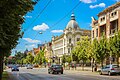
 Ante Starčević Square, Osijek's main city square
 -

-
 Osijek Main Post Office Building
.jpg)


Cultural events
[edit]Numerous cultural events take place in Osijek throughout the year. The long-running International Festival of Tambura Music (Međunarodni festival umjetničke tamburaške glazbe) is held annually in late spring and draws tambura ensembles from across Croatia and the region.
 Croatian National Theatre, Osijek, interior.
[69][70] During the summer months, the city hosts "Osijek Summer Nights" (Osječke ljetne večeri), a series of open-air cultural and entertainment events held on streets and promenades from June to August.[71][72] The Day of the City of Osijek (Dan grada Osijeka), celebrated on 2 December, is marked by cultural and artistic programmes and public events.[73][74][75]
The surrounding area, particularly the Kopački Rit nature park in Baranja, provides opportunities for guided boat tours, angling, and regulated hunting in designated zones, making it a popular destination for nature tourism and recreational fishing.[76][77]
Cuisine
[edit]The richness of local game and agricultural production has contributed to Osijek's reputation as a centre of Croatian gastronomy.[78] Local dishes include traditional Slavonian-style specialities such as kulen (paprika-flavoured sausage), various other sausages, ham, bacon, and dairy products. Other notable dishes are boiled dumplings, venison, čobanac (a spicy stew), and fish dishes such as fiš paprikaš (a paprika-based fish stew). The city's two locally brewed beer brands are Osječko and Esseker.[79][80]
Sport and recreation
[edit] Opus Arena
 Gradski vrt Hall
The Gradski vrt sports complex features the Gradski vrt Hall (Dvorana Gradski vrt), a multi-purpose arena built for the 2009 World Men's Handball Championship which has since hosted major events like the 2017 Davis Cup tie between Croatia and Spain.[81] The city annually hosts the Pannonian Challenge, an internationally recognized extreme sports festival for skateboarding, BMX, and inline skating.[82][83] The new Opus Arena, the home stadium of NK Osijek with a capacity of 13,005, was officially opened on 22 July 2023.[84]
The Copacabana recreational and sports centre, opened in 1980 on the left bank of the Drava River, provides facilities for various water sports during the summer months, including outdoor swimming pools and a sandy beach.[85][86] The city maintains numerous outdoor playgrounds and courts for football, handball, basketball, and tennis.[87][88] NK Osijek is the city's primary football club, competing in the First League. The team's organized supporters are known as the Kohorta Osijek.[89][90] Before the Second World War, the city's most successful club was Slavija Osijek, which was dissolved in 1941.[91]
A motorcycle speedway stadium was formerly located in the City Garden (Gradski vrt) area, on its north side. The Gradski stadion opened in October 1953 and closed in September 1987.[92] During its operation, it hosted a qualifying round of the Speedway World Championship in 1955, 1979, and 1982,[93] as well as a round of the 1977 Speedway World Cup.[94]
The Dvorana Gradski vrt, a multi-purpose sports hall, was constructed as a venue for the 2009 World Men's Handball Championship. It later hosted the 2017 Davis Cup World Group match between Croatia and Spain. Additionally, Osijek is the home of the annual Pannonian Challenge, an extreme sports festival that features competitions in skateboarding, inline skating, freestyle BMX, and MTB dirt racing.[95]
The new Opus Arena stadium, with a capacity of 13,005 spectators, was opened on 22 July 2023 with the official match of the first round of the Croatian First League between the NK Osijek and NK Slaven Belupo.[96]
Tourism, sights and attractions
[edit] Hotel Osijek
Osijek remains a popular domestic tourist destination, known for its Baroque architecture, expansive open spaces, and diverse recreational offerings. Key attractions include the main Ante Starčević Square, the 18th-century Baroque citadel of Tvrđa, the scenic promenade along the Drava River (promenada), and the pedestrian suspension bridge connecting the city to Baranja.[97][98][99]
The Municipal Park of King Petar Krešimir IV and Tomislav Park, both established in the early 20th century, are protected as national cultural landmarks.[100] The city contains one of Croatia's few zoological gardens, located along the Drava river.[101] A notable monument in the city honors Croatian political figure Ante Starčević.[102][103]
The Co-cathedral of St. Peter and Paul in Osijek is a Neo-Gothic structure designed by German architect Franz Langenberg, with contributions from Richard Jordan. Its tower, rising to 90 meters, is the second-highest church tower in Croatia.[104][105] Although its size and prominence often lead to it being called a cathedral, it served as a parish church until its elevation to a co-cathedral in 2008. The interior contains approximately 40 stained-glass windows, with the main altar and sculptures crafted by Eduard Hauser.[106] The building sustained significant damage during the Croatian War of Independence in the 1990s, resulting in the loss of some original features.

Festivals and Events
[edit]Osijek has become home to several large festivals and events, including Urban Fest Osijek, an annual music festival, and Pannonian Challenge, an annual extreme sports festival.[107]
Transport
[edit] Osijek cable-stayed Drava Highway Bridge, the longest bridge in Croatia. (81 metres longer than the Pelješac bridge)
Transport links to and from Osijek include major railway and highway junctions, a river port, and Osijek Airport. International flights from the airport to Cologne/Bonn Airport in Germany commenced in March 2008.[108] A four-lane highway, part of the Pan-European Corridor Vc, linking Osijek to the rest of the Croatian modern highway network, was completed and opened in April 2009. From Osijek, it is possible to take the train or bus to numerous destinations including, Zagreb, Rijeka, Požega, Virovitica, Našice, Slavonski Brod, Erdut, Vrpolje, Dalj, and Đakovo.[109][110]
 Osijek Airport (OSI), located near Klisa, is a key international airport and cargo hub in Eastern Croatia and Slavonia region.
A small tram network runs through the city, which has been in continuous operation since 1884, and is the only tram network still in operation in Croatia outside of Zagreb. The network is currently being completely overhauled and more than doubled in length, and the city's old trams have been thoroughly modernized.[111][112]
Notable people
[edit]Notable people who were born or have lived in Osijek include:
- Matija Petar Katančić, an 18th-century Croatian writer, professor of archaeology, translator of the Bible into Croatian, and author of the first paper on archaeology in Croatia.
- Josip Juraj Strossmayer, a Croatian Maecenas bishop.[113]
- Franjo Šeper, Archbishop of Zagreb from 1960 to 1968, and Prefect of the Congregation for the Doctrine of the Faith from 1968 to 1981.
- Francis, Duke of Teck, a German prince
- Oscar Nemon, sculptor
- Adolf Waldinger, painter
- Bela Čikoš Sesija, painter
- Franjo Kuhač, musicologist
- Franjo Krežma, violinist
- Miroslav Škoro, singer and former politician
- Branko Mihaljević, singer
- Krunoslav Slabinac, singer
- Ferdo Šišić, historian
- Snježana Kordić, linguist[113]
- Drago Hedl, investigative journalist and writer
- Vladimir Herzog, TV journalist
- Branko Lustig, Hollywood producer, Academy Award winner for Schindler's List and Gladiator, directed by Steven Spielberg and Ridley Scott, respectively.[113]
- Davor Šuker, footballer
- Franjo Glaser footballer
- Borna Barišić, footballer
- Jasna Šekarić, sport shooter
- Jelena Dokić, tennis player
- Donna Vekić, tennis player
- Lavoslav (Leopold) Ružička, winner of a 1939 Nobel Prize in Chemistry
- Vladimir Prelog, winner of a 1975 Nobel Prize in Chemistry
- Andrija Mohorovičić, meteorologist and seismologist
- Milutin Milanković, mathematician and climatologist
- Mijo Kišoatić, famous Croatian mineralogist and petrologist, first doctor of science (Ph.D.) in the field of natural sciences at the University of Zagreb.
- Ante Vukasović, Pedagogue and university professor
- Mia Dimšić, singer
Acknowledgements
[edit]Honorary citizens
[edit]- 1994: Siegbert Frank, Ćiril Kos, Vladimir Prelog
- 1995: Hans Dietrich Genscher, Bernard M. Luketich
- 1996: Geza Jeszenszky, Alois Mock
- 2001: Julije Knifer
- 2004: Branko Lustig
- 2008: Davor Šuker
- 2012: Ante Gotovina, Mladen Markač
- 2013: Jacques Paul Klein, Ive Mažuran
- 2016: Vladimir Šeks
- 2020: Lőrinc Mészáros
Source[114]
International relations
[edit]Twin towns – sister cities
[edit] Twin towns sign
|


Demographics
[edit]Ethnic composition (2021)
[edit]| Ethnic group | Population | Percentage |
|---|---|---|
| Croats | 88,391 | 91.77% |
| Serbs | 4,188 | 4.35% |
| Hungarians (Mađari) | 759 | 0.79% |
| Albanians | 353 | 0.37% |
| Germans (Nijemci) | 221 | 0.23% |
| Slovaks | 207 | 0.21% |
| Macedonians | 139 | 0.14% |
| Slovenes | 69 | 0.07% |
| Roma | 77 | 0.08% |
| Poles (Poljaci) | 12 | 0.01% |
| Romanians | 16 | 0.02% |
| Austrians | 16 | 0.02% |
| Russians | 9 | 0.01% |
| Other | 1,863 | 1.93% |
| Total (Grad Osijek) | 96,313 | 100.00% |
Partner cities
[edit]
|
References
[edit]Bibliography
[edit]- Cresswell, Peterjon; Atkins, Ismay; Dunn, Lily (10 July 2006). Time Out Croatia (First ed.). London, Berkeley & Toronto: Time Out Group Ltd & Ebury Publishing, Random House Ltd. 20 Vauxhall Bridge Road, London SV1V 2SA. ISBN 978-1-904978-70-1. Retrieved 10 March 2010.
Notes
[edit]- ^ Register of spatial units of the State Geodetic Administration of the Republic of Croatia. Wikidata Q119585703.
- ^ "Population by Age and Sex, by Settlements" (xlsx). Census of Population, Households and Dwellings in 2021. Zagreb: Croatian Bureau of Statistics. 2022.
- ^ a b "Population by Age and Sex, by Settlements, 2011 Census: Osijek". Census of Population, Households and Dwellings 2011. Zagreb: Croatian Bureau of Statistics. December 2012.
- ^ a b Özgüven, Burcu (2010). "A Convention Centre on the International Road: The Osijek Fair During the Ottoman Period [Uluslararasi Güzergah Üzerinde Bir Ticari Merkez: Osmanli Döneminde Ösek Panayiri]" (PDF). Alternatif Politika. 2 (1): 1–17. Archived (PDF) from the original on 23 April 2018.
- ^ Lewis, Charlton T. (1879). "Mursa or Mursĭa". A Latin Dictionary. Oxford, England: Clarendon Press. p. 1178. ISBN 978-0-19-864201-5.
}: ISBN / Date incompatibility (help) - ^ "Visit Osijek | Osijek". Visit Osijek | Osijek. Retrieved 23 November 2025.
- ^ Obelić, Bogomil; Škrivanko, Marija Krznarić; Marijan, Boško; Bronić, Ines Krajcar (2004). "Radiocarbon dating of Sopot culture sites (Late Neolithic) in eastern Croatia". Radiocarbon. 46 (1): 245–258. Bibcode:2004Radcb..46..245O. doi:10.1017/S0033822200039564.
- ^ Dizdar, Marko (2014). "Bronze belt from Osijek". In Guštin, Mitja; David, Wolfgang (eds.). The Clash of Cultures? The Celts and the Macedonian World (PDF). Schriften des kelten römer museums manching 9. Manching: Kelten Römer Museums. p. 189–200, page 189. ISBN 978-3-9812891-8-3.
- ^ Leleković, Tino (2017). "Hadrian and Mursa: The last colony". In Láng, Orsolya (ed.). Hadrianus MCM: Proceedings of the International Conference on the Occasion of the 1900th Anniversary of the Emperor Hadrian's Accession to the Throne. Budapest: Budapest History Museum. pp. 83–98, page 84. ISBN 978-615-5341-92-2.
- ^ a b Stallaerts, Robert (28 February 2010). Historical dictionary of Croatia. Scarecrow Press. p. 239. ISBN 978-0-8108-6750-5. Retrieved 15 October 2011.
- ^ "Middle Ages". City of Osijek: History. City of Osijek. 2010. Archived from the original on 8 October 2013.
- ^ Setton, Kenneth Meyer (1976). The Papacy and the Levant, 1204–1571. Vol. 3. American Philosophical Society. p. 249. ISBN 978-0-87169-161-3.
- ^ Mažuran, Ive (1958). "Turska osvajanja u Slavoniji (1526–1552)" [Turkish conquests in Slavonia (1526–1552)]. Osječki zbornik (in Croatian). 6: 93–134, pages 114–115.
- ^ Jelinic, Srecko (2002). "Popis Sandžaka Požega — 1579" [Register of Sandzak Pozega from 1579]. Pravni Vjesnik (in Croatian). 18: 337–338.
- ^ Dorling, Kindersley; Zopp, Leandro (6 June 2011). DK Eyewitness Travel Guide: Croatia. Dorling Kindersley Ltd. p. 189. ISBN 978-1-4053-6071-5. Retrieved 15 October 2011.
- ^ "Osijek after the Turks". City of Osijek: History. City of Osijek. 2010. Archived from the original on 8 October 2013.
- ^ Bousfield, Jonathan (July 2003). Rough guide to Croatia. Rough Guides. p. 126. ISBN 978-1-84353-084-8. Retrieved 15 October 2011.
- ^ Oliver, Jeanne (15 March 2005). Croatia. Lonely Planet. p. 85. ISBN 978-1-74059-487-5. Retrieved 15 October 2011.
- ^ Olson, Karen Tormé; Olson, Sanja Bazulic (14 April 2006). Frommer's Croatia. Frommer's. p. 307. ISBN 978-0-7645-9898-2. Retrieved 15 October 2011.
- ^ Osijek-history
- ^ a b Kordić, Snježana (1991). "Germanizmi u osječkom govoru danas" [Germanisms in modern Osijek speech] (PDF). In Andrijašević, Marin; Vrhovac, Yvonne (eds.). Prožimanje kultura i jezika (in Serbo-Croatian). Zagreb: Hrvatsko društvo za primijenjenu lingvistiku. p. 89. OCLC 443222199. S2CID 64774247. SSRN 3434569. CROSBI 447532. Archived from the original (PDF) on 18 April 2022. Retrieved 20 September 2021.
- ^ Hans Gehl: Die deutschen Stadtsprachen in Temeswar und Esseg. In: Velimir Petrović (Hrsg.): Essekerisch: Das Osijeker Deutsch. Edition Praesens, Wien 2001, S. 127–144.
- ^ Dorling, Kindersley; Zopp, Leandro (6 June 2011). DK Eyewitness Travel Guide: Croatia. Dorling Kindersley Ltd. p. 190. ISBN 978-1-4053-6071-5. Retrieved 15 October 2011.
- ^ Marković, Mirko (2018). "The Hungarians in Osijek at the Turn of the Century (1895-1918)". Papers from the 6th International Conference of the Society for the Study of the Hungarian History of Civilization.
- ^ a b One or more of the preceding sentences incorporates text from a publication now in the public domain: Chisholm, Hugh, ed. (1911). "Esseg". Encyclopædia Britannica. Vol. 9 (11th ed.). Cambridge University Press. p. 778.
- ^ Chisholm, Hugh, ed. (1911). . Encyclopædia Britannica. Vol. 7 (11th ed.). Cambridge University Press. p. 471.
- ^ Demo, Željko (1994). Ostrogothic coinage from collections in Croatia, Slovenia and Bosnia & Herzegovina. Narodni Muzej. ISBN 9788680651156. Retrieved 15 October 2011.
- ^ Zlodi, Goran (2009). "The Museum of Fine Arts in Osijek: From a Idea to the New Museum Building". Informatica Museologica.
- ^ Raiford, Neil Hunter (October 2004). Shadow: a Cottontail bomber crew in World War II. McFarland. p. 181. ISBN 978-0-7864-1906-7. Retrieved 15 October 2011.
- ^ Geiger, Vladimir (2011). The Expulsion of the Germans from Yugoslavia. University of Zagreb. ISBN 978-953-270-034-3.
- ^ "About Glas Slavonije". Glas Slavonije. Glas Slavonije d.d.
- ^ Jagodin, Nikola; Runjić, Vedran (2022). "Popis vatrogasnih organizacija s datumima osnivanja" [List of Firefighting Organisations with Date of Founding]. Muzej hrvatskog vatrogastva (in Croatian). Archived from the original on 30 January 2023.
- ^ "FOTO/VIDEO Tamburaški sastav Pajo Kolarić na 'Spli'skim litnjim kolurima'". Dalmatinski portal (in Croatian). Retrieved 22 August 2025.
- ^ "Ekonomski fakultet u Osijeku | EFOS – Povijest fakulteta". Efos.hr. Retrieved 16 September 2011.
- ^ "Poljoprivredni fakultet u Osijeku". Pfos.hr. Retrieved 16 September 2011.
- ^ "Faculty of Law in Osijek – Content". Pravos.hr. 26 November 2007. Archived from the original on 21 July 2011. Retrieved 16 September 2011.
- ^ Župna crkva Sv. Petra i Pavla Apostola u Osijeku
- ^ Jegen, Mary Evelyn (1996). Sign of Hope: the Centre for Peace, Nonviolence and Human Rights in Osijek. Uppsala, Sweden: Life & Peace Institute. p. 14. ISBN 978-91-87748-34-9.
- ^ Amoreta, Bajto (28 June 2012). "Dan osječkih branitelja: "Opća opasnost" večeras". HRT. Archived from the original on 30 November 2013. Retrieved 4 October 2013.
- ^ Former war mayor Branimir Glavas is sentenced on 9 years of jail and he is war criminal fugitive now. Osječka Hvidra osudila uhićenje svojih članova[permanent dead link], seebiz.eu; accessed 20 January 2016. (in Croatian)
- ^ DHMZ (21 January 2022). "Najniže izmjerene temperature zraka u Hrvatskoj za razdoblje od kada postoje mjerenja". Državni hidrometeorološki zavod.
- ^ DHMZ (19 July 2022). "Najviše izmjerene temperature zraka u Hrvatskoj za razdoblje od kada postoje mjerenja". Državni hidrometeorološki zavod.
- ^ DHMZ (21 January 2022). "Najniže izmjerene temperature zraka u Hrvatskoj za razdoblje od kada postoje mjerenja". Državni hidrometeorološki zavod.
- ^ DHMZ (21 January 2022). "Najniže izmjerene temperature zraka u Hrvatskoj za razdoblje od kada postoje mjerenja". Državni hidrometeorološki zavod.
- ^ DHMZ (21 January 2022). "Najniže izmjerene temperature zraka u Hrvatskoj za razdoblje od kada postoje mjerenja". Državni hidrometeorološki zavod.
- ^ "Osijek Climate Normals" (PDF). Croatian Meteorological and Hydrological Service. Retrieved 2 December 2015.
- ^ "Mjesečne vrijednosti za Osijek u razdoblju1899−2014" (in Croatian). Croatian Meteorological and Hydrological Service. Retrieved 3 December 2015.
- ^ László Zentai and Pál Kósa (eds.) Talma Kiadó Atlas and Gazetteer of Historic Hungary 1914 Archived 14 January 2017 at the Wayback Machine, Talma Kiadó, 2001
- ^ Statisztikai közlemények, 42. kötet (új sorozat), Budapest, 1912 Archived 29 May 2013 at the Wayback Machine
- ^ Stanovništvo prema nacionalnom sastavu i tipu naselja, popis 1981.
- ^ Popis stanovništva 1991, Republički zavod za statistiku – Zagreb
- ^ "Population by Ethnicity, by Towns/Municipalities, 2001 Census: County of Osijek-Baranja". Census of Population, Households and Dwellings 2001. Zagreb: Croatian Bureau of Statistics. 2002. Retrieved 13 January 2008.
- ^ "Population by Religion, by Towns/Municipalities, 2001 Census: County of Osijek-Baranja". Census of Population, Households and Dwellings 2001. Zagreb: Croatian Bureau of Statistics. 2002. Retrieved 13 January 2008.
- ^ "Mjesni odbori i gradske četvrti" (in Croatian). City of Osijek. Retrieved 8 October 2024.
- ^ "University of Osijek - Faculty of Agriculture". Faculty of Agriculture Osijek. University of Osijek.
- ^ Sharma, Soumitra (1997). Restructuring Eastern Europe: the microeconomics of the transition process. Edward Elgar Publishing. p. 144. ISBN 978-1-85898-576-3. Retrieved 15 October 2011.
- ^ "Contact". Osječka pivovara. Retrieved 13 September 2025.
- ^ "Distribution Centers - Croatia". Kandit. Retrieved 12 September 2025.
- ^ "Niveta, Osijek | Distribution". www.niveta.hr. Retrieved 13 September 2025.
- ^ Yugoslavia. Komisija za Ekonomsku Historiju Jugoslavije (1 January 1985). Acta historico-oeconomica Iugoslaviae: časopis za ekonomsku povijest Jugoslavije. Komisija za ekonomsku historiju Jugoslavije. Retrieved 15 October 2011.
- ^ "Disappearance and Sustainability of Historical Industrial Areas in Osijek (Croatia): Three Case Studies". Sustainability. 12 (2): 196. 8 February 2022. doi:10.3390/su12010196.
- ^ "Šutnja u Osijeku". Archived from the original on 9 March 2008. Retrieved 10 March 2008.
- ^ a b "Government calls early elections in Osijek for 9 March". Government of the Republic of Croatia. 24 January 2008. Archived from the original on 13 February 2008. Retrieved 10 March 2008.
- ^ Osijek: Pokušaj riješavanja krize Archived 16 October 2021 at the Wayback Machine, Hrvatska radiotelevizija, 26 December 2007; accessed 13 January 2008
- ^ IDS osuđuje trgovinu Vlade i Osijeka[permanent dead link], Hrvatska radiotelevizija, 21 December 2007; accessed 13 January 2008
- ^ HSP najjači u Osijeku Archived 11 March 2008 at the Wayback Machine, vijesti.hrt.hr; accessed 20 January 2016.(in Croatian)
- ^ "Manjinski izbori prve nedjelje u svibnju, kreću i edukacije". T-portal. 13 March 2023. Retrieved 2 May 2023.
- ^ "Informacija o konačnim rezultatima izbora članova vijeća i izbora predstavnika nacionalnih manjina 2023. XIV. OSJEČKO-BARANJSKA ŽUPANIJA" (PDF) (in Croatian). Državno izborno povjerenstvo Republike Hrvatske. 2023. pp. 15–18. Archived from the original (PDF) on 3 June 2023. Retrieved 3 June 2023.
- ^ Hrvatsko narodno kazalište Osijek / Hrvatski tamburaški savez — information on Međunarodni festival umjetničke tamburaške glazbe. Accessed 29 October 2025. https://hnk-osijek.hr/show/45-medunarodni-festival-umjetnicke-tamburaske-glazbe/
- ^ "International Festival of Tambura Music Osijek". osijek.hr. City of Osijek.
- ^ "Osijek Summer Nights". tzosijek.hr. Osijek Tourist Board.
- ^ Turistička zajednica Grada Osijeka (TZ Osijek), "Osijek Summer Nights" event listing / programme. Accessed 29 October 2025. https://www.tzosijek.hr/stranica.php?id=1212
- ^ "City of Osijek Day". osijek.hr. City of Osijek.
- ^ Total Croatia News / TZ Grad Osijek coverage of Osijek City Day (Dan grada Osijeka) and Advent/Kaleidoscope events. Accessed 29 October 2025. https://total-croatia-news.com/news/travel/osijek-city-day-advent-2021/
- ^ "PHOTOS: SPECTACULAR KALEIDOSCOPE LIGHTS OF OSIJEK CITY DAY AND ADVENT 2021". 2 December 2021.
- ^ "Visit Kopački Rit". Kopački Rit Nature Park. Public Institution for the Management of Protected Natural Areas in the Osijek-Baranja County.
- ^ Park prirode Kopački rit — official site / park overview (Kopački Rit Nature Park). Accessed 29 October 2025. http://pp-kopacki-rit.hr/
- ^ McKie, Robin. "Osijek: Croatia's gastronomic capital". National Geographic.
- ^ "Osijek's Craft Beer Tour, Where Croatian Beer Culture Began". Total Croatia. 3 May 2017. Retrieved 3 November 2025.
- ^ "Osječko pivo (Beer of Osijek) | Bruketa&Žinić&Grey – full service advertising agency". 22 January 2011. Retrieved 3 November 2025.
- ^ "Gradski vrt Sports Hall".
- ^ "Pannonian Challenge: The Story of the Festival". Total Croatia News.
- ^ "PC XXVI – Pannonian Challenge 2025". Retrieved 3 November 2025.
- ^ "Opus Arena – StadiumDB.com". stadiumdb.com. Retrieved 3 November 2025.
- ^ "Copacabana Beach". Osijek Tourist Board. Official Tourist Board.
- ^ "Osijek's shows its arty side: culture galore, more than ever before!" (PDF). Osijek in Your Pocket.
- ^ "Sports Facilities". City of Osijek. Official City Website.
- ^ "Sport and recreation". Medberatung. Retrieved 3 November 2025.
- ^ "NK Osijek". NK Osijek Official.
- ^ NK Osijek official website. “Kohorta – navijačka skupina NK Osijek.” Accessed 29 October 2025. https://nk-osijek.hr/klub/identitet/kohorta/
- ^ "Osijek".
- ^ "For many of us, a big dream has come true". Glas Slavonije. Retrieved 13 January 2024.
- ^ "History Speedway and Longtrack". Speedway.org. Retrieved 11 January 2024.
- ^ "1977 World Team Cup". International Speedway. Retrieved 13 January 2024.
- ^ Horvat, Karmen (23 November 2007). "Osijek sports hall construction contract signed". Javno.com. Archived from the original on 8 December 2008. Retrieved 20 January 2016.
- ^ "Stadion "Opus Arena"". nk-osijek.hr (in Croatian). Archived from the original on 26 July 2025. Retrieved 8 November 2025.
- ^ "Discover Osijek". Osijek Tourist Board. Official Tourist Board.
- ^ "Osijek Attractions". City of Osijek. Official City Website.
- ^ "20 great things to do in Osijek | Things to do | Time Out Croatia". Time Out Croatia. Archived from the original on 3 November 2024. Retrieved 14 July 2025.
- ^ "Green Osijek". Osijek Tourist Board. Official Tourist Board.
- ^ "Osijek Zoo". Zoološki vrt Osijek. Official Zoo Website.
- ^ "Ante Starčević Monument in Osijek". Croatia Week. 15 May 2018.
- ^ "Osječani rekli "Da" spomeniku Ocu Domovine – na glavnom trgu otkriven spomenik dr. Anti Starčeviću". City of Osijek. 13 June 2007. Archived from the original on 26 October 2007. Retrieved 28 August 2008.
- ^ "Co-Cathedral of Sts. Peter and Paul in Osijek | Culture & Art | Croatia4me - Jouw vakantie naar Kroatië begint hier!". Retrieved 3 November 2025.
- ^ "Co-Cathedral of St. Peter and St. Paul". Osijek Tourist Board. Official Tourist Board.
- ^ "Osijek Co-Cathedral". Archdiocese of Đakovo-Osijek. Official Archdiocese Website.
- ^ "History – PC XXVI". Retrieved 13 September 2025.
- ^ "First international flight departs from Osijek International Airport". Osijek Airport. 14 March 2008. Archived from the original on 20 May 2008. Retrieved 23 March 2008.
- ^ "OVERVIEW OF POTENTIALS AND BENEFITS – invitation to companies to Invest in Osijek" (PDF). Invest in Osijek Booklet.
- ^ "Croatian Motorways / Hrvatske autoceste — A5 motorway (part of Pan-European Corridor Vc)".
- ^ Építők, Magyar (26 March 2025). "Transport in Osijek on the verge of a revolution: renewal of the tram network and fleet". buildingconnections.eu. Retrieved 22 August 2025.
- ^ "UrbanRail.Net > Europe > Croatia > Osijek Tram - Straßenbahn". www.urbanrail.net. Retrieved 22 August 2025.
- ^ a b c T.M. (2 August 2022). "Notable people" (in Croatian). Zagreb: SiB.hr. RTL (Croatian TV channel). Archived from the original on 3 August 2022. Retrieved 4 August 2022.
- ^ Srčnik, Alan (2020). "Svi počasni građani Osijeka, od Preloga, preko Šukera, do Mészárosa… A imamo i neke do '80. godine…". osijekexpress.com (in Croatian). Retrieved 29 June 2023.
- ^ "Gradovi prijatelji". Grad Osijek (in Croatian). Archived from the original on 17 August 2021. Retrieved 30 May 2022.
- ^ "Osijek i Mostar postali gradovi prijatelji". osijek.hr (in Croatian). Osijek. 26 May 2022. Archived from the original on 26 May 2022. Retrieved 30 May 2022.
- ^ "Popis 2021". dzs.gov.hr. Retrieved 3 November 2025.

External links
[edit]

- Official website Archived 26 September 2007 at the Wayback Machine
- Osijek 031 city portal (in Croatian)
- Osijek Online Archived 11 September 2007 at the Wayback Machine (in Croatian)
- Osijek tourist information Archived 26 June 2007 at the Wayback Machine
| History | Coat of arms of Osijek | |
|---|---|---|
| Districts | ||
| Suburbs | ||
| Buildings and landmarks | ||
| Churches |
| |
| Culture | ||
| Galleries and museums | ||
| Education | ||
| Sports venues | ||
| Transport | ||
| Festivals | ||
| Neighboring municipalities | ||
| 100,000+ |  Coat of arms of Croatia Coat of arms of Croatia | |
|---|---|---|
| 50,000+ | ||
| 30,000+ | ||
| 15,000+ | ||
| 10,000+ | ||
Subdivisions of Osijek-Baranja County | ||
|---|---|---|
| Cities and towns |  Coat of arms of Osijek-Baranja County Coat of arms of Osijek-Baranja County | |
| Municipalities |
| |

| International | |
|---|---|
| National | |
| Geographic | |
| Other | |
