
Duisburg
Duisborg (Low German) | |
|---|---|
 Flag  Coat of arms | |
Location of Duisburg
within NRW
| |
 Location of Duisburg | |
  Duisburg  Duisburg | |
| Coordinates: 51°26′05″N 6°45′45″E / 51.43472°N 6.76250°E | |
| Country | Germany |
| State | North Rhine-Westphalia |
| Admin. region | Düsseldorf |
| District | Urban district |
| Subdivisions | 7 boroughs, 46 suburbs |
| Government | |
| • Lord mayor (2017–25) | Sören Link[1] (SPD) |
| • Governing parties | SPD / CDU[2] |
| Area | |
• City | 232.82 km2 (89.89 sq mi) |
| Elevation | 31 m (102 ft) |
| Population (2023-12-31)[3] | |
• City | 503,707 |
| • Density | 2,163.5/km2 (5,603.4/sq mi) |
| • Metro | 8,711,712 (Rhineland) |
| Time zone | UTC+01:00 (CET) |
| • Summer (DST) | UTC+02:00 (CEST) |
| Postal codes | 47001–47279 |
| Dialling codes | 0203 |
| Vehicle registration | DU |
| Website | www.duisburg.de |


Duisburg (German: [ˈdyːsbʊʁk] ⓘ; Low German: Duisborg, pronounced [ˈdʏsbɔɐ̯χ]) is a major city in the western part of Germany, located in the state of North Rhine-Westphalia. With around half a million inhabitants, it is one of the largest cities in the Ruhr urban area and part of the larger Rhine-Ruhr metropolitan region, one of the biggest population centers in Europe. Duisburg is situated at the confluence of the Ruhr and the Rhine, a geographic position that has historically made it an important center of trade, industry, and transportation. Administratively, Duisburg forms an independent city (kreisfreie Stadt).
The city is known for hosting the world's largest inland port, the Port of Duisburg, which plays a key role in European logistics and international trade. The port's facilities are directly linked to major motorways, rail networks, and the Rhine waterway, connecting Duisburg to the North Sea and beyond. Today, Duisburg is a hub for the steel, chemical, and logistics industries, and it has also become an important node in trade relations with China, being a key terminus for freight trains on the Chongqing–Xinjiang–Europe railway.
Historically, Duisburg traces its origins back to a Frankish settlement and was first documented in the 9th century. During the Middle Ages, it developed as a trading town on the Rhine and briefly served as a member of the Hanseatic League. Although the city lost importance after the silting of its old Rhine port in the late medieval period, it gained renewed significance with the rise of heavy industry in the 19th century. The expansion of coal mining, ironworks, and steel production transformed Duisburg into one of Germany's key industrial centers during the Industrial Revolution.
Modern Duisburg combines its industrial legacy with cultural and educational institutions such as the University of Duisburg-Essen, one of the largest universities in Germany. The city is also home to theaters, museums, and sports venues, while its industrial heritage sites, such as the Landschaftspark Duisburg-Nord, have been repurposed into landmarks of cultural tourism. Like much of the Ruhr area, Duisburg has undergone structural change in recent decades, shifting from heavy industry to a more diversified economy that includes services, logistics, and research.
Status
[edit]Duisburg is a city in Germany's Rhineland, the fifth-largest city (after Cologne, Düsseldorf, Dortmund and Essen) in the nation's most populous constituent state of North Rhine-Westphalia. Its 500,000 inhabitants make it Germany's 15th-largest city. Located at the confluence of the Rhine river and its tributary the Ruhr river, it lies in the west of the Ruhr urban area, Germany's largest, of which it is the third-largest city after Dortmund and Essen. The Ruhr itself lies within the larger Rhine-Ruhr Metropolitan Region, one of Europe's largest conurbations. The city lies on both sides of the Rhine, with the city center and most boroughs on the river's right bank, and is the only city of the Rhine-Ruhr region lying on both the Rhine and Ruhr rivers. Duisburg is one of the largest cities in the Meuse-Rhenish (closely related to Dutch) dialect area and the largest in the Kleverlandish area (north of the Uerdingen Isogloss).
Duisburg has the world's largest inland port,[4] "Duisburg-Ruhrorter Häfen", in Duisburg-Ruhrort. Germany's fourth-largest and the Rhine-Ruhr region's main airport, Düsseldorf Airport, lies near the city, in Düsseldorf-Lohausen. With 42,747 students, the University of Duisburg-Essen is Germany's ninth-largest university. It has campuses in Essen and Duisburg, and a university hospital in Essen. Duisburg is a result of numerous incorporations of surrounding towns and smaller cities. The city is renowned for its steel industry. All blast furnaces in the Ruhr are now located in Duisburg. In 2000, 49% of all hot metal and 34.4% of all pig iron in Germany were produced here. It also has a large brewery, König. In the early Middle Ages, it was a royal court of the Franks, first mentioned in writing in 883.
Etymology
[edit]The first syllable of the name of the city could go back to the Proto-Indo-European root *dʰeus-, meaning something like "wet area" or "flood plain".[citation needed] Duisburg therefore could mean "fortified place in the floodplain". Another interpretation assumes that the name is derived from the Old German "duis" which means "hill".[citation needed] Duisburg could mean something like "castle on the hill". Thus, a place on a hill overlooking the Rhine, that could refer to the area of the present Town Hall. Duisburggau (Diuspurgau) was also the name of the medieval Gau (country subdivision) on the Lower Rhine.
History
[edit]A legend recorded by Johannes Aventinus (fl. 1525) holds that Duisburg (along with Deutz, Cologne, Duisdorf in Bonn, and Doesburg in the Netherlands) was built by the namesake Tuisto, mythical progenitor of Germans, about 2395 BCE. There is nothing to establish any historical basis for such an early founding of Duisburg, which would have made it among the earliest cities in Europe.
Roman period and Middle Ages
[edit] Remains of the city wall
Duisburg developed at the confluence of the Ruhr and the Rhine, on the outer bank of the Rhine and at the western end of the Hellweg trade route.[5] Continuous settlement in the city's core area can be traced from the 1st century, initially Roman and from the 5th century onward Frankish.[5]
In 420, the Franks seized the former Roman settlement and recolonised it. By the 8th century, a Frankish–Carolingian royal estate had been established, which later developed into a palatinate.[5] The first recorded mention of Duisburg dates from 883, when Norman raiders captured the settlement and remained there over the winter.
Due to the town's favorable geographic position a palatinate was built and the town was soon granted the royal charter of a free city. Duisburg became a member of the Hanseatic League. Around 1000 the river Rhine moved westward from the town. This put an end to the Duisburg's development as a trading town and it soon transformed into a predominantly agrarian settlement.
Construction of the city wall began in 1120, and the “city charter” was granted by King Lothar III in 1279. By 1290, Duisburg had become part of the County (and, after 1417, the Duchy) of Cleves. In 1445, an attack by Archbishop-Elector Dietrich II von Moers (de) of the Electorate of Cologne was successfully repelled.
Early modern period
[edit] Corputius plan of Duisburg, completed in 1566
The Reformation spread to Duisburg only gradually around the mid-16th century.[5] Refugees from the Netherlands and England contributed to the city's increasing Calvinist orientation.[5]
In 1566, Johannes Corputius completed his city map of Duisburg. The city's reputation as “Educated Duisburg” (“Duisburgum Doctum”) was established through the work of cartographer Gerardus Mercator and the founding of a university in 1655.[5] By 1666 the city, still within the Duchy of Cleves, became incorporated into Brandenburg-Prussia.
The city's commercial activity revived in 1674 with the establishment of a regular shipping route to the Netherlands.[5] Trade, particularly in colonial goods, led to the development of a significant freight forwarding industry, as well as textile, tobacco, and sugar factories, which became the city's most important economic sectors.[5]
Industrial revolution
[edit] Binnenhafen in 1931
The rise of tobacco and textile industries in the 18th century made Duisburg an industrial center. Big industrial companies such as iron and steel producing firms (Thyssen and Krupp) influenced the development of the city within the Prussian Rhine Province. Large housing areas near production sites were being built as workers and their families moved in.
In 1823, a district (Landkreis) of Duisburg was established, encompassing the neighboring cities of Essen and Mülheim an der Ruhr. The following year, in 1824, the construction of the sulfuric acid factory Fr. W. Curtius marked the beginning of the industrial era in Duisburg. With the construction of a canal connecting the city to the Rhine beginning in 1826, Rhine trade regained considerable importance.[5] In 1828, Franz Haniel founded a dockyard for steamships, further contributing to the city's economic development. From 1844 onward, the connection to the Ruhr enabled Duisburg to participate in the growing coal trade.[5] As the port expanded to handle timber, ore, and especially grain, Duisburg's port became the second-largest Rhine port after Ruhrort.[5]
Duisburg's connection to the expanding railway network began in the 1840s, with the railway line to Düsseldorf completed in 1846, followed by the railway line via Dortmund to Minden in 1847. The city became an independent city borough in 1873, and by 1904 it celebrated the birth of its 100,000th resident, Ernst R. Straube. Increasing competition between the ports of Duisburg and Ruhrort led, in 1905, to the merger of the ports, followed soon after by the unification of the cities of Duisburg, Ruhrort, and Meiderich.[5]
On 8 March 1921, French infantry occupied Duisburg to secure war reparation payments incurred during World War I. In 1929, Duisburg was merged with the neighboring city of Hamborn to form the new city of Duisburg-Hamborn. This name was later shortened to Duisburg in 1935.
In November 1938, during the Kristallnacht pogroms organized by the Nazis, the city's synagogue was destroyed.
World War II
[edit]A major logistical center in the Ruhr and location of chemical, steel and iron industries, Duisburg was a primary target of Allied bombers, with industrial areas and residential blocks targeted by Allied incendiary bombs.
On the night of 12–13 June 1941, British bombers dropped a total of 445 tons of bombs in and around Duisburg. As part of the Battle of the Ruhr, another British raid of 577 bombers destroyed the old city between 12 and 13 May 1943 with 1,599 tons of bombs. During the bombing raids, 96,000 people were made homeless with countless lives lost.
In 1944, the city was again badly damaged as a total of 2,000 tons of bombs were dropped on 22 May. On 14 October, the tonnage was repeated with 2,018 tons when Halifax, Lancaster, and Mosquito bombers appeared over Duisburg as part of Operation Hurricane. This daylight raid was followed by a night attack; over 24 hours about 9,000 tons of HE and incendiaries had been dropped on Duisburg. Numerous similar attacks followed until the end of 1944.
The Allied ground advance into Germany reached Duisburg in April 1945. The US 17th Airborne Division, acting as regular infantry and not in a parachute role, met only scattered resistance in the vicinity and captured the city on 12 April 1945.[6]
On 8 May 1945, the ADSEC Engineer Group A, led by Col. Helmer Swenholt, commanding officer of the 332nd Engineer General Service Regiment, constructed a railway bridge between Duisburg and Rheinhausen across the Rhine. It was 860 metres (2,820 ft) long, and constructed in six days, fifteen hours and twenty minutes, a record time. It was named the "Victory Bridge".[7]
Federal Republic of Germany
[edit] Memorial to the victims of the Love Parade disaster
A total of 299 bombing raids had almost completely destroyed the historic cityscape. 80% of all residential buildings had been destroyed or partly damaged.[citation needed] Almost the whole of the city had to be rebuilt, and most historic landmarks had been lost.[citation needed]
Beginning in the mid-1960s, the decline of Duisburg's steel and mining industry caused a significant loss of residents. While in 1975 approximately 590,000 people were living in Duisburg, the number had shrunk to 518,000 in 1985.
Duisburg celebrated its 1100th anniversary in 1983. The city's population recovered a little in the following years, up to 537,000 in 1992. It declined to 488,000 in 2011. On 19 July 2004, it was hit by a tornado. The municipal theater and parts of the city center were damaged. The city hosted the 7th World Games in 2005. In 2010, 21 people died because of a mass panic at the Love Parade; over 500 people were injured.[8]
In March 2011, the inaugural freight train of the Chongqing–Xinjiang–Europe Railway arrived in Duisburg and since then the city has served as the railway's western terminus.[9]
On 7 April 2025 15 schools were closed after an unknown far right extremist sent multiple bomb threats.[10]
Geography
[edit]Duisburg is in the Lowland Rhine area at the confluence of the Rhine and Ruhr and near the outskirts of the Bergisches Land. The city spreads along both sides of these rivers.
Adjacent cities
[edit]The following cities border Duisburg (clockwise starting from the north-east): Oberhausen, Mülheim an der Ruhr, Ratingen, Düsseldorf, Meerbusch, Krefeld, Moers, Rheinberg, Voerde and Dinslaken.
Districts
[edit]Since 1 January 1975, Duisburg has been divided into seven districts or boroughs (Stadtbezirke) from north to south:[11]
- Walsum (51,528)
- Hamborn (71,528)
- Meiderich/Beeck (73,881)
- Homberg/Ruhrort/Baerl (41,153)
- Duisburg-Mitte (center) (105,961)
- Rheinhausen (77,933)
- Duisburg-Süd (73,321)
Climate
[edit]Duisburg has an oceanic climate (Köppen: Cfb).[12] On 25 July 2019, Duisburg recorded a temperature of 41.2 °C (106.2 °F), which is the highest temperature to have ever been recorded in Germany.[13]
| Climate data for Duisburg (Jan 2021 - Dec 2025) | |||||||||||||
|---|---|---|---|---|---|---|---|---|---|---|---|---|---|
| Month | Jan | Feb | Mar | Apr | May | Jun | Jul | Aug | Sep | Oct | Nov | Dec | Year |
| Record high °C (°F) | 16.8 (62.2) |
20.2 (68.4) |
25.8 (78.4) |
25.9 (78.6) |
30.0 (86.0) |
33.3 (91.9) |
39.5 (103.1) |
35.1 (95.2) |
32.2 (90.0) |
25.4 (77.7) |
18.2 (64.8) |
17.5 (63.5) |
39.5 (103.1) |
| Mean daily maximum °C (°F) | 6.3 (43.3) |
9.0 (48.2) |
13.0 (55.4) |
15.1 (59.2) |
20.3 (68.5) |
24.7 (76.5) |
25.0 (77.0) |
25.2 (77.4) |
21.9 (71.4) |
16.8 (62.2) |
10.6 (51.1) |
7.7 (45.9) |
16.3 (61.3) |
| Daily mean °C (°F) | 4.2 (39.6) |
6.0 (42.8) |
8.3 (46.9) |
10.2 (50.4) |
14.7 (58.5) |
19.2 (66.6) |
19.4 (66.9) |
19.6 (67.3) |
16.8 (62.2) |
13.0 (55.4) |
7.8 (46.0) |
5.6 (42.1) |
12.1 (53.7) |
| Mean daily minimum °C (°F) | 2.0 (35.6) |
3.0 (37.4) |
3.8 (38.8) |
5.2 (41.4) |
9.0 (48.2) |
13.2 (55.8) |
14.1 (57.4) |
14.2 (57.6) |
12.1 (53.8) |
9.5 (49.1) |
5.0 (41.0) |
3.2 (37.8) |
7.9 (46.2) |
| Record low °C (°F) | −6.6 (20.1) |
−10.3 (13.5) |
−3.2 (26.2) |
−2.9 (26.8) |
.5 (32.9) |
4.9 (40.8) |
8.5 (47.3) |
6.7 (44.1) |
4.6 (40.3) |
1.7 (35.1) |
−2.9 (26.8) |
−7.6 (18.3) |
−10.3 (13.5) |
| Average rainfall mm (inches) | 77 (3.0) |
59 (2.3) |
46 (1.8) |
60 (2.4) |
77 (3.0) |
74 (2.9) |
83 (3.3) |
72 (2.8) |
82 (3.2) |
72 (2.8) |
67 (2.6) |
70 (2.8) |
839 (32.9) |
| Source: Wetterdienst.de[14] | |||||||||||||
| Climate data for Duisburg | |||||||||||||
|---|---|---|---|---|---|---|---|---|---|---|---|---|---|
| Month | Jan | Feb | Mar | Apr | May | Jun | Jul | Aug | Sep | Oct | Nov | Dec | Year |
| Mean daily maximum °C (°F) | 5.5 (41.9) |
7.0 (44.6) |
10.4 (50.7) |
14.8 (58.6) |
18.5 (65.3) |
22.0 (71.6) |
23.3 (73.9) |
23.1 (73.6) |
19.6 (67.3) |
15.0 (59.0) |
9.7 (49.5) |
6.4 (43.5) |
14.6 (58.3) |
| Daily mean °C (°F) | 3.5 (38.3) |
4.3 (39.7) |
6.7 (44.1) |
10.4 (50.7) |
14.2 (57.6) |
17.6 (63.7) |
19.0 (66.2) |
18.7 (65.7) |
15.4 (59.7) |
11.6 (52.9) |
7.4 (45.3) |
4.4 (39.9) |
11.1 (52.0) |
| Mean daily minimum °C (°F) | 1.4 (34.5) |
1.8 (35.2) |
3.3 (37.9) |
5.9 (42.6) |
9.7 (49.5) |
13.0 (55.4) |
14.8 (58.6) |
14.6 (58.3) |
11.6 (52.9) |
8.8 (47.8) |
5.1 (41.2) |
2.5 (36.5) |
7.7 (45.9) |
| Average rainfall mm (inches) | 72.2 (2.84) |
66.8 (2.63) |
64.3 (2.53) |
52.9 (2.08) |
72.1 (2.84) |
72.6 (2.86) |
94.4 (3.72) |
88.3 (3.48) |
66.5 (2.62) |
76.5 (3.01) |
74.3 (2.93) |
75.9 (2.99) |
876.8 (34.53) |
| Average snowfall mm (inches) | 7.1 (0.28) |
7.2 (0.28) |
3.2 (0.13) |
0.7 (0.03) |
0.0 (0.0) |
0.0 (0.0) |
0.0 (0.0) |
0.0 (0.0) |
0.0 (0.0) |
0.0 (0.0) |
1.9 (0.07) |
8.2 (0.32) |
28.3 (1.11) |
| Average relative humidity (%) | 85.8 | 81.6 | 76.1 | 70.0 | 70.9 | 70.8 | 72.4 | 75.1 | 79.2 | 83.4 | 86.9 | 87.5 | 78.3 |
| Mean monthly sunshine hours | 24.0 | 67.8 | 135.6 | 206.8 | 234.0 | 247.2 | 249.6 | 226.2 | 163.4 | 94.7 | 35.6 | 12.6 | 1,697.5 |
| Source: Weather.Directory[12] | |||||||||||||
Politics
[edit]Mayor
[edit]The current mayor of Duisburg is Sören Link of the Social Democratic Party (SPD), who was elected in 2012 and re-elected in 2017 and 2025.
The most recent mayoral election was held on 14 September 2025 with a runoff election being held on 28 September, and the results were as follows:
| Candidate | Party | First round | Second round | |||
|---|---|---|---|---|---|---|
| Votes | % | Votes | % | |||
| Sören Link | Social Democratic Party | 77,637 | 46.0 | 121,272 | 78.6 | |
| Carsten Groß | Alternative for Germany | 33,282 | 19.7 | 33,079 | 21.4 | |
| Gerhard Meyer | Christian Democratic Union | 24,558 | 14.5 | |||
| Sebastian Ritter | The Greens | 10,684 | 6.3 | |||
| Barbara Laakmann | The Left | 7,761 | 4.6 | |||
| Ayhan Yildirim | Duisburg Alternative List-We Shape Duisburg | 4,445 | 2.6 | |||
| Oliver Beltermann | Young Duisburg | 3,407 | 2.0 | |||
| Erkan Kocalar | Sahra Wagenknecht Alliance | 3,040 | 1.8 | |||
| Oliver Alefs | Free Democratic Party | 1,527 | 0.9 | |||
| Dagmar Schink | Die PARTEI | 1,429 | 0.9 | |||
| Britta Söntgerath | Volt Germany | 1.100 | 0.7 | |||
| Valid votes | 168,870 | 99.4 | ||||
| Invalid votes | 1,077 | 0.6 | ||||
| Total | 169,947 | 100.0 | ||||
| Electorate/voter turnout | 351.441 | 48.4 | ||||
| Source: City of Duisburg | ||||||
City council
[edit]The Duisburg city council (Duisburger Stadtrat) governs the city alongside the mayor. The most recent city council election was held on 14 September 2025, and the results were as follows:
| Party | Votes | % | ± | Seats | ± | |
|---|---|---|---|---|---|---|
| Social Democratic Party (SPD) | 54,925 | 32.6 |  2.1 2.1
|
34 | 2
| |
| Alternative for Germany (AfD) | 35,671 | 21.2 | 11.9
|
22 | 12
| |
| Christian Democratic Union (CDU) | 29,284 | 17.4 |  4.1 4.1
|
18 | 4
| |
| Alliance 90/The Greens (Grüne) | 15,348 | 9.1 | 8.6
|
10 | 9
| |
| The Left (Die Linke) | 10,099 | 6.0 | 0.5
|
6 | ±0 | |
| Young Duisburg (JUDU) | 5,684 | 3.4 | 0.4
|
4 | 1
| |
| Sahra Wagenknecht Alliance (BSW) | 3,562 | 2.1 | New | 2 | New | |
| Duisburg Alternative List-We Shape Duisburg (DAL-WGD) | 3,297 | 2.0 | New | 2 | New | |
| Human Environment Animal Protection (Tierschutz) | 3,191 | 1.9 | ±0 | 2 | ±0 | |
| Free Democratic Party (FDP) | 2,521 | 1.5 | 1.6
|
2 | 1
| |
| Active Citizens' Initiative (ABI) | 1,643 | 1.0 | New | 1 | New | |
| Social, Just, Independent (SGU) | 1,553 | 0.9 | 0.1
|
1 | ±0 | |
| Volt Germany (Volt) | 788 | 0.5 | New | 0 | New | |
| Die PARTEI (PARTEI) | 642 | 0.4 | 0.8
|
0 | 1
| |
| Independent Future Marxloh | 282 | 0.2 | New | 0 | New | |
| Pirate Party Germany (PIRATEN) | 30 | New | 0 | New | ||
| Valid votes | 168,520 | 99.2 | ||||
| Invalid votes | 1,334 | 0.8 | ||||
| Total | 169,854 | 100.0 | 104 | 2
| ||
| Electorate/voter turnout | 351,441 | 48.3 | 9.2
|
|||
| Source: City of Duisburg | ||||||
State parliament
[edit]In the Landtag of North Rhine-Westphalia, Duisburg is divided between three constituencies: 61 Duisburg I (containing Süd district and most of Mitte), 62 Duisburg II (Walsum, Rheinhausen, and most of Homberg/Ruhrort/Baerl), and 63 Duisburg III (Hamborn, Meiderich/Beeck, and parts of Mitte and Homberg/Ruhrort/Baerl). After the 2022 North Rhine-Westphalia state election, all three constituencies were held by the SPD. Duisburg I was represented by Sarah Philipp, Duisburg II by Rainer Bischoff, and Duisburg III by Frank Börner.
Federal parliament
[edit]In the Bundestag, Duisburg is divided between two constituencies: 115 Duisburg I (Rheinhausen, Süd, and Mitte) and 116 Duisburg II (Walsum, Hamborn, Meidereich/Beeck, Homberg/Ruhrort/Baerl). In the 21st Bundestag, both are held by the SPD. Duisburg I is represented by Federal Minister of Labour and Social Affairs Bärbel Bas, and Duisburg II by Mahmut Özdemir.
Demographics
[edit]In 2010, Duisburg had a population of 489,600, a slight decrease since 2006.
| Year | Pop. | ±% |
|---|---|---|
| 1714 | 2,983 | — |
| 1810 | 5,195 | +74.2% |
| 1871 | 30,533 | +487.7% |
| 1900 | 92,729 | +203.7% |
| 1910 | 229,483 | +147.5% |
| 1919 | 244,302 | +6.5% |
| 1925 | 272,252 | +11.4% |
| 1933 | 440,419 | +61.8% |
| 1939 | 434,646 | −1.3% |
| 1950 | 410,783 | −5.5% |
| 1961 | 504,975 | +22.9% |
| 1970 | 454,839 | −9.9% |
| 1975 | 591,635 | +30.1% |
| 1980 | 558,089 | −5.7% |
| 1985 | 518,260 | −7.1% |
| 1990 | 535,447 | +3.3% |
| 2001 | 512,030 | −4.4% |
| 2011 | 488,468 | −4.6% |
| 2022 | 501,415 | +2.7% |
| Population size may be affected by changes in administrative divisions. source:[15][circular reference][16] | ||
Duisburg has one of the highest proportions of Muslims in Germany, with the city's Muslim population at approximately 15%, or 71,000 residents, as of 2011.[17]
Population structure of non-German residents:[18]
| Rank | Nationality | Population (31 December 2022)[19] |
|---|---|---|
| 1 |  Turkey Turkey |
33,768 |
| 2 |  Bulgaria Bulgaria |
12,143 |
| 3 |  Syria Syria |
9,423 |
| 4 |  Ukraine Ukraine |
9,068 |
| 5 |  Romania Romania |
8,853 |
| 6 |  Poland Poland |
5,423 |
| 7 |  Italy Italy |
3,805 |
| 8 |  Serbia Serbia |
2,488 |
| 9 |  Greece Greece |
2,381 |
| 10 |  Croatia Croatia |
2,044 |
| 11 |  Bosnia and Herzegovina Bosnia and Herzegovina |
1,944 |
| 12 |  North Macedonia North Macedonia |
1,489 |
| 13 |  Kosovo Kosovo |
1,445 |
| 14 |  Netherlands Netherlands |
1,427 |
| 15 |  Spain Spain |
1,272 |
| 16 |  Morocco Morocco |
1,249 |
| 17 |  Malaysia Malaysia |
1,204 |
Turkish community
[edit]Duisburg is home to 85,000 people of Turkish origin.[20] Other estimates suggest that the Turkish population is as large as 100,000.[21][22][23] The new Merkez Mosque, one of the largest Muslim places of worship in Western Europe, was built with help by the way of contribution of 3.2 million euro from the EU and the state of North Rhine-Westphalia.[24] Asiye Nur Fettahoğlu, a Turkish-German actress, was born in Duisburg on 12 November 1980.[25]
Culture
[edit]Duisburg hosts a comprehensive range of cultural facilities and events. A highlight is the annual "Duisburger Akzente",[26] a festival focusing on modern social, political and cultural topics.
Alongside Düsseldorf, Duisburg is one of the seats of the Deutsche Oper am Rhein, one of the major opera houses in Germany. The Duisburg Philharmonic Orchestra is one of Germany's orchestras with an international reputation.
Due to its history as a harbour city and a trade and industrial center, Duisburg offers a variety of architectural places of interest, such as the German Inland Waterways Museum. Buildings vary from old churches such as St. Johann Baptist in Duisburg-Hamborn, which was built in 900, to modern age buildings such as Micro-Electronic-Centrum in Duisburg-Neudorf, built in 1995. Another subject of interest is the Landschaftspark Duisburg-Nord[27] an abandoned industrial complex open to the public and an Anchor Point of ERIH, The European Route of Industrial Heritage. The city center contains the Wilhelm Lehmbruck Museum,[28] the municipal theatre[29] and the shopping street known as the "fountain mile".
The city also contains two botanical gardens, the Botanischer Garten Duisburg-Hamborn and the Botanischer Garten Kaiserberg, as well as a number of municipal parks.
On 24 July 2010, 21 people were killed and hundreds injured in the city during the Love Parade disaster.[30] The Love Parade was an electronic dance music festival and technoparade.
-
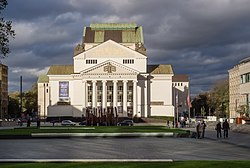 Theater Duisburg, venue of the Duisburg Philharmonic
 -
 St. Johann Baptist Abbey
 -
 Landschaftspark Nord ("Landscape Park North"), on a former industrial estate
 -
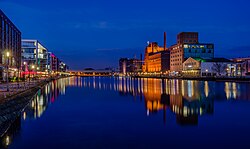 Old inner harbour
 -
 Botanical Garden Kaiserberg
 -
 König Pilsner brewery
 -

-
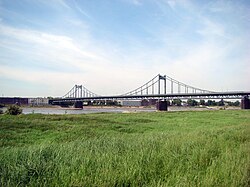 Krefeld-Uerdinger bridge


Local dialect
[edit]As with the Venlo dialect, the city's local dialect, the Düsberjesch, called Duisburger Platt in German, is a tonal dialect of the Kleverlandish heavily influenced historically by the Bergish dialects of the Limburgish language spoken in its southern boroughs.[citation needed]
Transport
[edit] Watershed of the Rhine
Duisburg Port
[edit]Port of Duisburg is the city's inland port. It is officially regarded as a seaport because seagoing river vessels go to ports in Europe, Africa and the Middle East. Numerous docks are mostly located at the mouth of the Ruhr where it joins the Rhine.
Each year more than 40 million tonnes of various goods are handled with more than 20,000 ships calling at the port. The public harbour facilities stretch across an area of 7.4 square kilometres (2.9 sq mi). There are 21 docks covering an area of 1.8 km2 (0.7 sq mi) and 40 kilometres (25 miles) of wharf. The area of the Logport Logistic Center Duisburg stretches across an area of 2.65 km2 (1.02 sq mi). With 2.5 million TEU it is also the largest inland container port, based on 2011 figures.[31] A number of companies run their own private docks and 114 million tonnes of goods yearly (2010) are handled in Duisburg in total.[needs update]
Roads
[edit]Duisburg is served by several autobahns, with 3 east–west routes and 2 north–south routes. A3 forms a bypass east of the city and mostly serves through traffic. A59 runs parallel to A3 and serves the city from north to south with 14 interchanges, much more than most other cities in the Ruhr area. The A40 and A42 are two east–west routes that serve central and northern Duisburg. Autobahn A40 also serves major through traffic from the Netherlands to Berlin and points east. A short spur, A524 serves southern Duisburg. Most Autobahns have six lanes or are upgraded to six lanes (A59).
Apart from the autobahns, no Bundesstraßen serve the city directly. B8 runs through the city, but uses A59's alignment. B288 runs in the extreme south of the city, and serves traffic to and from Krefeld. Several bridges span the Rhine, most prominently the A40 and A42 bridges, but also the L287 suspension bridge and the L237 arch bridge, a three-lane bridge with 2 lanes per peak direction with dynamic lane usage.
Public transport
[edit]Duisburg Hauptbahnhof is served by the InterCityExpress and InterCity long-distance network of the Deutsche Bahn, in addition line S1 of the S-Bahn line connects Duisburg with other cities of the Rhine-Ruhr area.
The Duisburg Stadtbahn, the Duisburg tramway network, and a bus system, all operated by the Duisburger Verkehrsgesellschaft, provide local services. Stadtbahn line U79, the so-called "D-Bahn" ("D-Line"), connects to the neighbouring city of Düsseldorf and is operated jointly with the Rheinbahn of Düsseldorf. All S-Bahn, Stadtbahn, and bus lines operate under the umbrella of the Verkehrsverbund Rhein-Ruhr.
Media
[edit]There are several newspapers reporting on local events and politics, including the Westdeutsche Allgemeine Zeitung (WAZ), the Neue Ruhr Zeitung (NRZ) and the Rheinische Post (RP). The local radio station "Radio Duisburg" was the first local radio broadcaster in the German state of North Rhine-Westphalia. It started broadcasting in 1990. There is a local television station ("STUDIO 47"), which was the first local station to broadcast in North Rhine-Westphalia. It started broadcasting in 2006. In its Duisburg studios the WDR produces a local programme for the city of Duisburg and the Lower Rhine region north of Düsseldorf. WDR is part of the German television and radio network ARD.
Sport
[edit]| Club | Sport | League | Venue |
|---|---|---|---|
| MSV Duisburg | Football | 3. Liga | MSV-Arena |
| Rhein Fire | American football | European League of Football (ELF) | MSV-Arena |
| Füchse Duisburg | Ice hockey | Oberliga (3rd District League) | PreZero Rheinlandhalle |
| MSV-Duisburg | Women's football | Women's Bundesliga | MSV-Arena |
| Duisburg Dockers | Baseball, American football | Landesliga II (2nd District League) | Schwelgernstadion |
| Amateur SC Duisburg | Water polo | Deutsche Wasserball-Liga (1st Water Polo League) | Schwimmstadion and club pool |
| Club Raffelberg | Hockey | Regionalliga West (3rd Hockey League) | Kalkweg |
Duisburg hosts a variety of sports activities and events, with football being the most prominent among residents. The local football club, MSV Duisburg, plays a central role in the city's sporting culture. MSV Duisburg plays its home matches at the MSV-Arena, a modern stadium accommodating football, American football, and other sporting events.
Duisburg served as one of the host cities for the 2005 World Games during the summer of 2005.[32] During the 2006 FIFA World Cup, the city was used as the training base for the Portuguese national team, while the Italian national team, which went on to win the tournament, was accommodated there.
The city is known for the Rhein-Ruhr-Marathon, as well as for its rowing and canoeing regattas, which regularly include international championships. Other popular sports in Duisburg include ice hockey, basketball, American football, water polo, and field hockey.
Notable people
[edit]- Gerardus Mercator (1512–1594), Flemish cartographer, inventor of the Mercator projection
- Ludwig Susen (1807–1863), elementary teacher
- August Thyssen (1842–1926), industrialist
- Wilhelm Lehmbruck (1881–1919), sculptor
- Fritz Springorum (1886–1942), industrialist and politician
- Oswald Pohl (1892–1951), Nazi SS officer executed for war crimes
- Paul Bäumer (1896–1927), World War I flying ace
- Margot Philips (1902–1988), New Zealand painter
- Ferdinand Simoneit (1925–2010), journalist and author
- Lüder Lüers (1926–2022), German horticultural architect, engaged in founding Kindernothilfe
- Dieter Kürten (born 1935), sports journalist
- Achim Warmbold (born 1941), rally driver
- Daisy Door (born 1944), Schlager music singer
- Ronny van Dyke (born Jörg T. Hartmann in 1956), singer and songwriter
- Frank Peter Zimmermann (born 1965), violinist
- Christoph Reuter (born 1968), musicologist
- Christian Ehring (born 1972), comedian
- Stefan Gertler (born 1972), singer
- Ramin Djawadi (born 1974), German-Iranian composer and music producer
- Sören Link (born 1976), German politician
- Nur Fettahoğlu (born 1980), Turkish-German actress
- André Lotterer (born 1981), Belgian-German racing driver
- Fabian Schrumpf (born 1982), German politician
- Lance David Arnold (born 1986), racing driver
- Benjamin Leuchter (born 1987), racing driver
- Nikolas Breuckmann (born 1988), mathematical physicist
- Jacob Goll (born 1992), ice hockey player
- Ena Mahmutovic (born 2003), footballer
- Carmen Nicole Moelders
Twin towns – sister cities
[edit] Portsmouth, England, UK (1950)
 Calais, France (1964)
 Wuhan, China (1982)
 Vilnius, Lithuania (1985)
 Gaziantep, Turkey (2005)
 Perm, Russia (2007)
 San Pedro Sula, Honduras (2008)
 Lomé, Togo (2010)
 Fort Lauderdale, United States (2011)
 Kryvyi Rih, Ukraine (2023)


References
[edit]- ^ Oberbürgermeisterwahl Stadt Duisburg 24.09.2017, accessed 4 October 2022.
- ^ "Groko im Duisburger Rat: Weiter so statt Neuanfang". 11 November 2021.
- ^ "Alle politisch selbständigen Gemeinden mit ausgewählten Merkmalen am 31.12.2023" (in German). Federal Statistical Office of Germany. 28 October 2024. Retrieved 16 November 2024.
- ^ Cioc, Mark (17 November 2009). The Rhine: An Eco-Biography, 18152000. University of Washington Press. ISBN 9780295989785. Retrieved 11 December 2016 – via Google Books.
- ^ a b c d e f g h i j k l Kraume, Hans Georg. "Stadt Duisburg". Internetportal Rheinische Geschichte (in German). Landschaftsverband Rheinland (LVR). Retrieved 2025-10-11.
- ^ Stanton, Shelby, World War II Order of Battle: An Encyclopedic Reference to U.S. Army Ground Forces from Battalion through Division, 1939–1946 (revised ed., 2006), Stackpole Books, p. 97.
- ^ Peacock, Jim; Peacock, Tom. "Duisberg". Geocities. Yahoo. Archived from the original on 24 October 2009. Retrieved 5 May 2009.
- ^ "Duisburg-Ticker: Trauerzug durch den Tunnel - Kraft fordert indirekt Rücktritt". Der Spiegel (in German). 2010-07-28. ISSN 2195-1349. Retrieved 2025-04-12.
- ^ "China-Europe freight train reaches Duisburg". ecns.cn. China News Service. 2024-12-04. Retrieved 2025-10-10.
- ^ "Germany: Schools closed over extremist right threats – DW – 04/07/2025". dw.com. Retrieved 2025-04-12.
- ^ "Population statistics". Statistisches Landesamt NRW. Archived from the original on 9 February 2008.
- ^ a b "Duisburg Weather & Climate Guide". Weather.Directory. Retrieved 7 Sep 2025.
- ^ "DWD-Stationen Duisburg-Baerl und Tönisvorst jetzt Spitzenreiter mit 41,2 Grad Celsius". www.dwd.de (in German). 17 December 2020. Retrieved 4 January 2021.
- ^ "Climate Duisburg - Station Duisburg-Baerl (24 m)". Wetterdienst.de. Retrieved 24 Jan 2026.
- ^ Link
- ^ "Germany: States and Major Cities".
- ^ "Muslime in Deutschland 2011 – Landkreise – Karte (Islam-Karte)". Kartenseite (in German). 2017-04-05. Retrieved 2023-10-25.
- ^ "Ausländer_2006-2007_Kreise.xls" (PDF). Archived from the original (PDF) on 10 July 2012. Retrieved 26 March 2013.
- ^ "Duisburger Quartalszahlen" (PDF). Retrieved 18 June 2018.
- ^ "50 Jahre Deutsch-Türkisches Anwerbeabkommen | 50 jähriges Jubiläum zum Anwerbeabkommen der Türkei und der BRD". 50jahre.wir-sind-du.de (in German). Retrieved 12 March 2013.
- ^ "TGRT Haber » Haberler » Dünya » Almanya'nın en büyük camisine yoğun ilgi". Tgrthaber.com. Archived from the original on 30 March 2012. Retrieved 12 March 2013.
- ^ ""Das ist Volkesstimme" – Thilo Sarrazin in Duisburg". Xtranews.de. 30 November 2010. Retrieved 12 March 2013.
- ^ "Türk Edebiyatı Avrupa'da". On5yirmi5.com. Retrieved 12 March 2013.
}: CS1 maint: deprecated archival service (link) - ^ Quantara.de retrieved 25 July 2008
- ^ "Nur Fettahoglu | Actress". IMDb. Retrieved 2023-11-27.
- ^ GmbH, Duisburg Marketing. "38. Duisburger Akzente 2017 – Theater, Bildende Kunst & Literatur". Retrieved 11 December 2016.
- ^ "Duisburg-Nord Landscape Park". Landschaftspark.de. 23 April 2009. Retrieved 5 May 2009.
- ^ "Cynapsis – Die Kommunikations-Agentur in Münster". Lehmbruck.cynapsis.com. Retrieved 5 May 2009.
- ^ "Theater Duisburg – Startseite". Retrieved 11 December 2016.
- ^ Connolly, Kate (25 July 2010). "Love Parade stampede in Germany kills at least 18 - latimes.com". Los Angeles Times. Retrieved 25 July 2010.
- ^ Top 100 Container Ports 2012 Archived 4 June 2013 at the Wayback Machine
- ^ "The World Games 2005, Duisburg". The World Games. Retrieved 2026-01-22.
- ^ "Städtepartnerschaften". duisburg.de (in German). Duisburg. Retrieved 12 February 2021.
Bibliography
[edit]External links
[edit]

- Official website
 (in German)
 - Visit-Duisburg.com English Tourist Information by City of Duisburg
- Gemeindeblatt der Jüdischen Gemeinde Duisburg (1928–1932) is a digitized periodical at the Leo Baeck Institute, New York

Members of the Hanseatic League by quarter, and trading posts of the Hanseatic League | ||||
|---|---|---|---|---|
| ||||
| Wendish |
|   | ||
| Saxon | ||||
| Baltic | ||||
| Westphalian | ||||
| Kontore | ||||
| Vitten | ||||
| Factories | ||||

World Games host cities | |
|---|---|


| International | |
|---|---|
| National | |
| Geographic | |
| Other | |